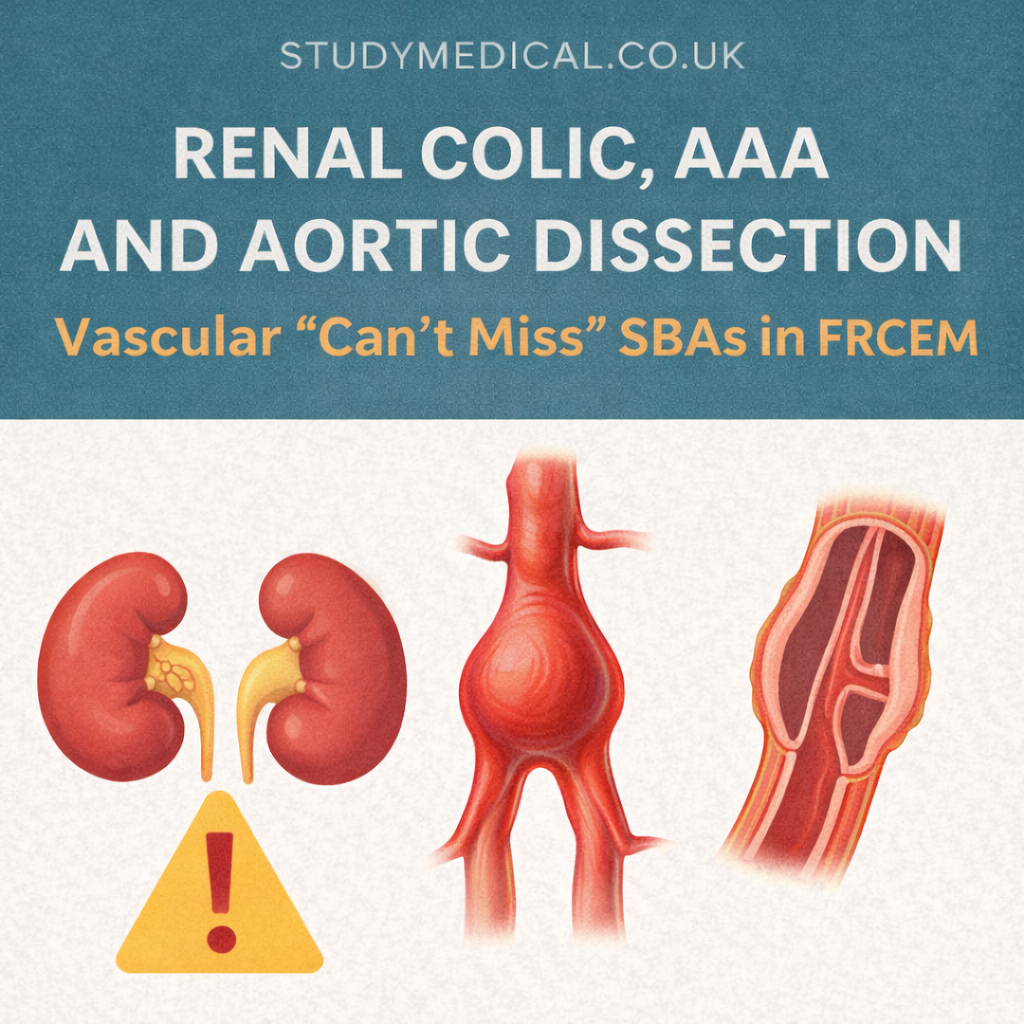
Renal Colic, AAA and Aortic Dissection for FRCEM SBA: A Practical Guide for Emergency Medicine Doctors
What Are Renal Colic, AAA and Aortic Dissection and Why Do They Matter in the ED?
Renal colic, abdominal aortic aneurysm (AAA) and aortic dissection all present with sudden severe torso pain – but only one is usually benign. Renal colic is typically due to ureteric obstruction by a stone; it’s common, intensely painful but rarely immediately life-threatening.(RCEM Learning)
In contrast, AAA (especially ruptured) and acute aortic dissection (part of acute aortic syndrome) are time-critical vascular catastrophes with high mortality if missed. RCEM, NICE and vascular guidelines all emphasise early recognition, targeted imaging (non-contrast CT for stones; CT angiography for aortic disease) and rapid involvement of urology or vascular surgery as appropriate.(NICE)
For the FRCEM SBA, these conditions appear repeatedly as “can’t miss” chest/abdominal/back pain scenarios, testing whether you spot red flags for aortic catastrophe hiding in what looks like “just another renal colic”.
How This Topic Appears in the FRCEM SBA Exam
Typical question angles:
- Diagnosis / recognition
- Classic renal colic vs AAA vs aortic dissection from vignette details.
- Recognising shock from ruptured AAA vs septic shock vs haemorrhage elsewhere.(RCEM Learning)
- Initial investigation choice
- Non-contrast CT KUB vs ultrasound vs CT angiography in different age/comorbidity groups.(NICE)
- Bedside aortic ultrasound in shocked older patients.
- First-line management
- NSAIDs first line in renal colic; when opiates and antiemetics are added.(RCEM Learning)
- Permissive hypotension and fast vascular referral in suspected ruptured AAA.(RCEM)
- Blood pressure and pain control in aortic dissection.
- Complications / red flags
- Obstructed infected system (septic stone).(NICE)
- Signs of impending rupture or extension of dissection (syncope, neuro deficit, limb ischaemia, new AR murmur).(RCEM Learning)
Example scenario:
A 68-year-old man with hypertension presents with sudden left flank and back pain, “like renal colic”. He is pale, BP 86/50, HR 120, no history of stones. The SBA is really asking: “Will you treat this as renal colic or call vascular and get an urgent aortic scan?”
Core Concepts You Must Know About Renal Colic, AAA and Aortic Dissection
Definitions & Key Criteria
- Renal colic – acute colicky loin-to-groin pain due to obstruction of the ureter, most commonly by stones. Frequently associated with microscopic/macroscopic haematuria, nausea/vomiting and restlessness.(RCEM Learning)
- Abdominal aortic aneurysm (AAA) – focal dilatation of the abdominal aorta ≥3.0 cm (≈1.5× normal diameter). Ruptured AAA carries mortality up to 85–90%.(RCEM Learning)
- Acute aortic dissection – tear in the intima allowing blood to track between layers of the aortic wall; part of acute aortic syndrome (with intramural haematoma and penetrating aortic ulcer). Guidelines emphasise early CT angiography and risk stratification using clinical features and imaging.(RCEM Learning)
Assessment & Investigations
Shared first steps
- ABCDE, analgesia, IV access, broad bloods (FBC, U&E, lactate, clotting, group & save/crossmatch).
- Pregnancy test in women of childbearing age.
Renal colic
- History: colicky unilateral loin-to-groin pain, restlessness, previous stones, minimal abdominal tenderness.
- Red flag questions: fever, rigors, reduced urine output, known single kidney, anticoagulation.
- Investigations:
- Urine dip (haematuria, infection markers).
- Bloods including creatinine and CRP.
- Imaging:
- NICE NG118 and BAUS/NICE commentary: urgent imaging within 24 hours for suspected renal/ureteric stones; CT KUB is the usual first-line in adults, ultrasound considered in young/pregnant patients or to reduce radiation.(NICE)
AAA / ruptured AAA
- History: older (typically ≥60), male sex, smoking history, hypertension, sudden severe abdominal/back/loin pain, often with collapse/syncope.
- Exam: hypotension, tachycardia, tender or pulsatile abdominal mass, cool peripheries.
- Investigations:
- Point-of-care ultrasound to look for AAA (≥3 cm) – good for rule-in in shocked patients.(RCEM Learning)
- CT angiography if haemodynamically stable and diagnosis unclear; otherwise straight to vascular / theatre per local pathway and national SOPs.(RCEM)
Aortic dissection
- History: sudden, severe “tearing” chest/back pain; may migrate.
- Exam: hypertension or shock; BP or pulse asymmetry, neurological deficit, focal limb ischaemia, new diastolic murmur (aortic regurgitation).(RCEM Learning)
- Investigations:
- ECG and troponin (often normal or non-specific – don’t be reassured).
- Chest X-ray may show mediastinal widening but can be normal – again, not reassuring.(RCEM Learning)
- CT angiography of the aorta is the diagnostic test of choice in ED per RCEM/RCR best practice.(RCEM Learning)
Initial ED Management
Renal colic
- Rapid NSAID analgesia (IV/IM/oral) is first line unless contraindicated; opiates as second line.(RCEM Learning)
- Antiemetics, fluids if needed, and early imaging/referral if pain not settling or red flags present.
- Suspected infected obstructed system → urgent urology involvement and IV antibiotics.
Ruptured or leaking AAA
- Treat as time-critical major haemorrhage:
- Call senior/vascular team early.
- Permissive hypotension (e.g. systolic ~80–90 mmHg if conscious) until control of bleeding, avoiding large-volume crystalloid; crossmatch blood and activate massive haemorrhage protocol if needed.(RCEM)
- Avoid unnecessary delays for CT in an obviously shocked, AAA-type presentation if theatre access is available.
Aortic dissection
- Analgesia and anti-impulse therapy – control heart rate and blood pressure (e.g. IV labetalol per local protocol, unless contraindicated) while arranging CT and cardiothoracic/vascular input.(NHS England)
- Avoid thrombolysis unless you are sure you’re not dealing with dissection masquerading as ACS.
Red Flags and Pitfalls
High-yield red flags:
- “Renal colic” pain in a >60-year-old with hypotension or collapse → AAA until proven otherwise.(RCEM Learning)
- Chest or back pain with neurological deficit, pulse/BP asymmetry or new AR murmur → dissection.(RCEM Learning)
- Renal colic-like pain with fever and sepsis markers → think obstructed infected system (urological emergency).(NICE)
Classic pitfalls:
- Ordering CT KUB in an unstable older patient instead of aortic imaging / vascular referral.
- Being reassured by a normal CXR or troponin in possible dissection.(RCEM Learning)
- Over-resuscitating ruptured AAA with litres of crystalloid, worsening bleeding.
Special Populations (optional)
- Pregnancy – ultrasound and MRI are preferred; radiation-sparing strategies and early obstetric involvement. (Nice to mention but often not deeply tested).
- Young stone-formers – more likely true renal colic; still don’t ignore infection or solitary kidney.
Common FRCEM SBA Traps Related to This Topic
- Old = automatic renal colic label
- Trap: 72-year-old with back/loin pain and hypotension treated as “renal colic” with diclofenac and CT KUB.
- Avoid: age + shock + back/abdominal pain = AAA until proven otherwise.
- Wrong imaging test
- Trap: Ordering abdominal ultrasound instead of CT angiography in suspected dissection, or CT KUB when vascular catastrophe is more likely.
- Avoid: Non-contrast CT KUB → stones; CT angiography → aorta; POCUS → quick AAA rule-in.
- Ignoring infection with stones
- Trap: Sending home a febrile stone patient with oral antibiotics.
- Avoid: Obstructed infected system = urgent decompression + IV antibiotics.
- Over-resuscitation in ruptured AAA
- Trap: “BP 80? Give 2L fluid bolus!”
- Avoid: follow permissive hypotension and rapid transfer to theatre.
- Missing subtle dissection
- Trap: Discharging “musculoskeletal back pain” with red flag features (migrating pain, neuro deficit, pulse asymmetry).
- Avoid: low threshold for CT angiography when RCEM/RCR aortic dissection guideline criteria are met.(RCEM Learning)
High-Yield Clinical Patterns for This Topic in the ED
Classic Presentation
Renal colic
35-year-old with sudden severe left loin-to-groin pain, writhing in agony, afebrile, normal observations, microscopic haematuria, no peritonism.
Ruptured AAA
72-year-old smoker with sudden back and abdominal pain, collapse at home, BP 78/50, HR 120, pale, clammy, tender pulsatile abdominal mass.
Aortic dissection
60-year-old with sudden “tearing” chest pain radiating to the back, BP 190/100 in right arm, 150/90 in left, early diastolic murmur, ECG non-diagnostic.
Atypical Presentation
- “Renal colic” in an older patient with vague abdominal discomfort and syncope.
- Dissection presenting as ischaemic stroke, limb ischaemia or ACS-like chest pain.
Dangerous Mimics
- Renal colic vs AAA – age, haemodynamic stability, palpable mass, degree of tenderness and shock guide you.
- ACS vs dissection – chest pain with neurological signs/BP differential → image aorta, not cath lab first.
- Pyelonephritis vs infected stone – obstruction + sepsis = urological emergency, not just medical sepsis.
How to Revise This Topic Efficiently for the FRCEM SBA
Use Question Banks First, Then Guidelines
- Do a block of SBAs focusing on:
- Flank pain, chest/back pain, shock with abdominal pain, and imaging choice.
- Then skim:
- NICE NG118 (renal and ureteric stones – imaging within 24 h, early intervention).(NICE)
- RCEM/RCR best practice on aortic dissection and RCEM resources on AAA.(RCEM Learning)
- RCEMLearning modules like Renal Colic in Emergency Medicine and Just another renal colic.(RCEM Learning)
Build Mini-Notes or Flashcards from Mistakes
Each time you miss a question:
- Extract the rule you forgot:
- “Age >60 + collapse + loin pain = AAA first.”
- “Unstable + suspected aortic dissection = CT angio (if possible) and anti-impulse therapy.”
- “Febrile renal colic = obstructed infected system until proven otherwise.”
Mix Text-Based and Image-Based Questions
- Use CT images of stones, ultrasound/CT snippets of AAA, and CTA images of dissection where possible.
- Practise interpreting non-contrast CT KUB reports vs CTA aorta reports – exactly the style RCEM like.
How StudyMedical Covers This Topic in Its FRCEM SBA Question Bank
StudyMedical threads these “vascular can’t-miss” conditions through multiple categories (Abdominal Pain, Cardiology, Vascular, Renal, Resus):
- Curriculum-mapped questions on renal colic, AAA and aortic dissection, each with full vitals, examination findings and realistic ED narratives.
- Image-based SBAs:
- Non-contrast CT KUB for stones, ultrasound clips of AAA, and CT angiography for dissection.
- Guideline-driven explanations:
- Referencing NICE NG118, RCEM/RCR best practice for aortic dissection, and RCEM guidance on ruptured AAA and ED abdominal pain.(NICE)
- Smart revision modes let you repeatedly hit your weak spot – for example, “renal colic vs AAA” scenarios – until the red flags are automatic.
FAQs About This Topic in the FRCEM SBA
How often do renal colic, AAA and aortic dissection appear in the FRCEM SBA?
Very often in some form. You’ll almost certainly see renal colic and at least one aortic catastrophe case in any sizable paper, often disguised as generic “abdominal pain” or “back pain” questions.
What’s the single most important thing to remember for the exam?
In older or haemodynamically unstable patients, never label pain as renal colic until you’ve excluded AAA/aortic dissection.
Are there must-know guidelines?
Yes:
- NICE NG118 – renal and ureteric stones assessment, imaging and intervention timelines.(NICE)
- RCEM/RCR aortic dissection best practice and national SOPs for acute aortic syndrome.(RCEM Learning)
- RCEM/vascular guidance on ruptured AAA and permissive hypotension.(RCEM)
How many related questions should I do before the exam?
Aim for at least 20–30 SBAs focused on this theme (renal colic, AAA, dissection, imaging choice, shock with abdominal/back pain), plus mixed papers where they appear alongside other emergencies.
Key Takeaways: This Topic for FRCEM in 5 Bullet Points
- Renal colic is common; AAA and dissection are rare but lethal – in older or unstable patients, think aorta first.
- Use the right imaging: non-contrast CT KUB for stones; CT angiography (and POCUS for AAA) for aortic disease.
- Recognise red flags: age >60, shock, syncope, pulsatile mass, BP asymmetry, neuro deficits.
- Follow guidelines: NICE NG118 for stones, RCEM/RCR for dissection, RCEM/vascular guidance for AAA.(NICE)
- Drill SBAs until you instinctively choose the safe, guideline-aligned option when faced with “renal colic vs vascular catastrophe” scenarios.
Ready to Test Yourself on These Vascular “Can’t Miss” SBAs?
Renal colic, AAA and aortic dissection are classic FRCEM territory:
- They’re common (or catastrophic) in real life.
- They map cleanly onto vignette + “next best investigation/management” style questions.
- Getting them right is the difference between missing a life-threatening diagnosis and saving a life.