Why this topic is suddenly high-yield
RCUK’s 2025 Adult ALS guidance keeps the core algorithm the same, but gives greater emphasis to effective ventilation—and it explicitly includes mechanical ventilator settings during CPR that are perfect for FRCEM SBA questions. (resus.org.uk)
If you revise nothing else: know the 10/min rule, and know the ventilator settings list.
The SBA-ready summary
If an advanced airway is in place (ETT or SGA)
- Ventilate at 10 breaths/min
- Continuous chest compressions (do not pause for breaths)
- If using an SGA and there’s significant leak causing inadequate ventilation, revert to 30:2 (pause compressions for breaths).
If using a mechanical ventilator during CPR (RCUK ALS 2025)
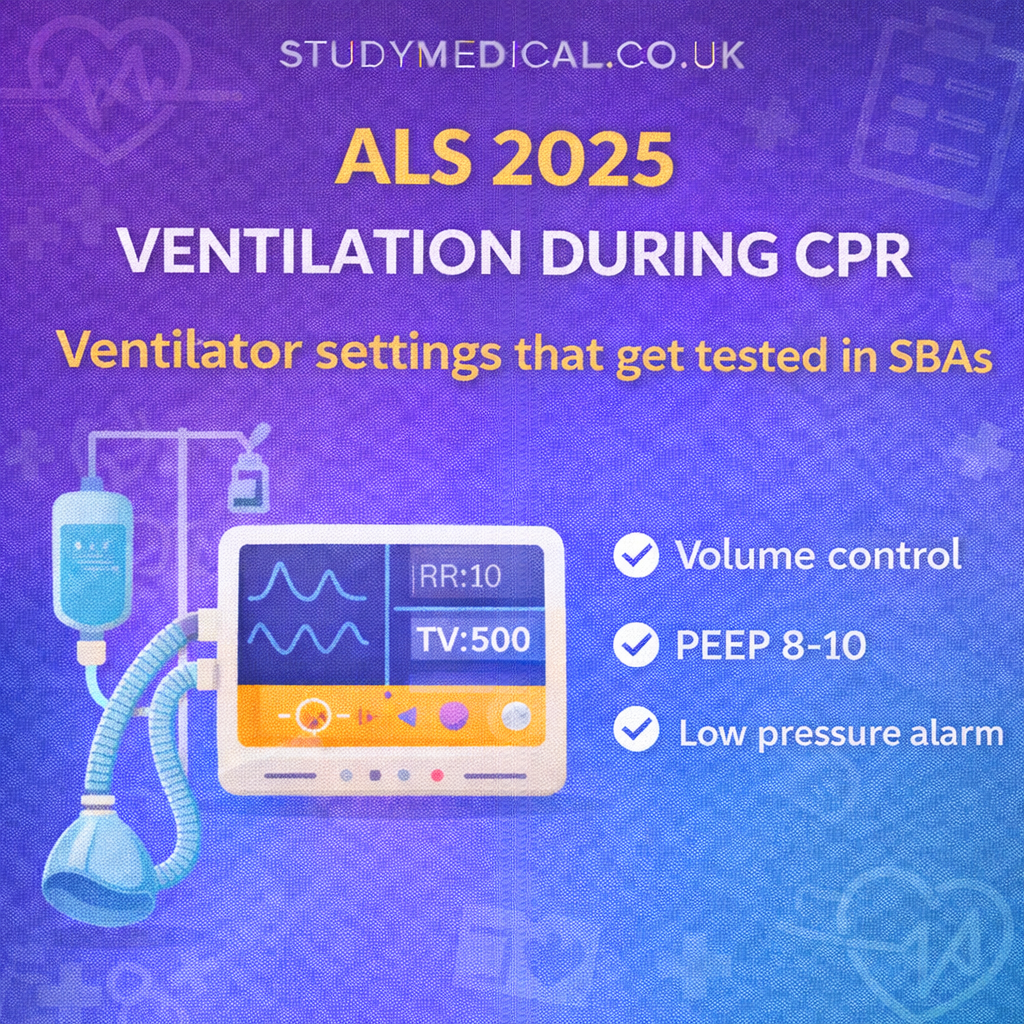
Use volume-controlled mode during chest compressions and set:
- VT: 6–8 mL/kg predicted (ideal) body weight (or just enough for visible chest rise)
- FiO₂: maximum inspired oxygen
- Rate: 10/min
- Inspiratory time: 1–2 seconds
- PEEP: 0–5 cmH₂O
- Peak pressure alarm: 60–70 cmH₂O
- Flow trigger: OFF
- If ventilation is ineffective: switch to manual ventilation
That line about flow trigger OFF is a classic examiner favourite.
What RCUK 2025 expects you to do before you even touch the ventilator
RCUK is clear that airway/ventilation in CPR is stepwise:
- Start with basic airway manoeuvres and escalate according to rescuer skill until effective ventilation is achieved
- Use the highest feasible inspired oxygen during CPR
- Aim for ventilation that avoids both hypoventilation and hyperventilation (so rate + tidal volume matter)
- Bag-mask ventilation should be optimised (seal + airway patency); use a two-person technique if needed
- Give each breath over ~1 second to achieve visible chest rise
SBA trap: “Intubate early for better ventilation” is not automatically correct. RCUK states intubation should only be attempted by rescuers with a high success rate, using continuous waveform capnography, and with minimal interruption to compressions.
How SBAs frame this: “The ventilator is already there—what do you set it to?”
This crops up in ED/ICU-interface scenarios:
- Arrest in resus with a ventilator in the bay
- Peri-intubation arrest
- Post-ROSC patient who re-arrests while already ventilated
- Transfer/CT arrest where the patient is on a transport vent
The question usually asks for the single best setting change (e.g., “turn off the trigger”) or the best set of parameters.
The common wrong answers (and why they’re wrong)
- RR 20–30/min → hyperventilation trap (reduces time for venous return during compressions and is explicitly what the guideline wants you to avoid).
- Pressure support / spontaneous modes → inappropriate during CPR because compressions can confuse triggering and synchrony (RCUK specifies volume-controlled mode + trigger off).
- High PEEP (10–15) → not the guideline default during CPR (RCUK: 0–5).
- Leaving flow trigger on → can cause auto-triggering during compressions (RCUK: OFF).
- Huge tidal volumes → RCUK gives 6–8 mL/kg predicted body weight (or just enough for chest rise).
The “hidden” ventilation detail that gets tested: defibrillation safety
If you’re ventilating during shocks, examiners love to test oxygen/fire safety.
RCUK states:
- Remove any oxygen mask (e.g., nasal cannulae/BVM) and keep it ≥1 m away from the chest
- If using a mechanical ventilator, direct oxygen exhaust away from the chest
- Keep the self-inflating bag or ventilator circuit attached to the SGA/ETT
SBA trap: “Disconnect the ventilator circuit before defibrillation” is not what this guidance says—don’t confuse “move oxygen away from the chest” with “disconnect the airway.”
A mini SBA-style example (so you can spot the pattern)
Scenario: A 62-year-old has an in-ED VF arrest. They are intubated with waveform capnography. You decide to ventilate using the mechanical ventilator during ongoing CPR.
Which ventilator adjustment is most appropriate?
Best answer: Turn the flow trigger OFF and use volume-controlled ventilation at RR 10/min with VT 6–8 mL/kg predicted body weight, PEEP 0–5.
If an option includes “RR 10/min” but leaves the trigger on (or chooses a spontaneous mode), that’s often the examiner’s “almost-right” distractor.
Practical checklist for your next arrest (and your next SBA)
If you see “ventilation during CPR ventilator settings” in a stem, mentally tick these off:
- Advanced airway in place?
- Yes → 10/min + continuous compressions
- SGA leak?
- If inadequate ventilation → revert to 30:2
- Ventilator being used?
- Volume control, VT 6–8 mL/kg PBW, FiO₂ max, RR 10, Ti 1–2 s, PEEP 0–5, pressure alarm 60–70, trigger OFF
- Waveform capnography in place?
- Required to exclude oesophageal intubation and to monitor ventilation effectiveness
- Defib safety with oxygen
- Mask away, exhaust away, circuit stays attached