If you work in emergency medicine, paediatric resuscitation is one of those areas where you need two things at once: calm pattern recognition and up-to-date guideline knowledge. The Resuscitation Council UK (RCUK) 2025 paediatric life support guidance is now the core UK reference point, adapted from the European Resuscitation Council (ERC) 2025 guideline set. It covers the deteriorating child, paediatric cardiac arrest, special circumstances, and post-resuscitation care, with a stronger focus on structured systems, early recognition and context-specific decision-making than previous versions.
For FRCEM SBA candidates, the high-yield point is this: the 2025 update is not a total rewrite of paediatric life support, but it does sharpen several details that are very testable. The biggest themes are airway optimisation, more explicit fluid and vasoactive advice, refinement of the shockable arrest pathway, and clearer guidance on trauma, sepsis, PE, electrolyte problems, hypothermia and other special circumstances.
Who produced the 2025 paediatric resuscitation guidance?
The UK guidance comes from RCUK, which publishes national recommendations tailored to UK practice. These are aligned with the broader ERC 2025 guideline programme, itself informed by international evidence review through ILCOR processes. In practical terms, this means the 2025 paediatric guidance reflects the current mainstream European and UK evidence base for paediatric resuscitation.
When do you use paediatric life support rather than newborn life support?
One easily examined detail is the boundary between PLS and NLS. RCUK defines paediatric patients as 0 to 18 years. The guidance states that NLS can still be used during neonatal or maternity-unit stays, and in the out-of-hospital setting if the baby is under 24 hours old. Outside those situations, paediatric algorithms generally apply, although local policy, case mix and team familiarity still matter.
What has changed in the deteriorating child?
Airway: oxygenation matters more
The 2025 guideline places more emphasis on maintaining oxygenation during intubation. It advises clinicians to consider apnoeic oxygenation or high-flow nasal oxygen, to limit each intubation attempt to 30 to 60 seconds, and to stop immediately if there is bradycardia or oxygen desaturation. It also recommends limiting intubation to four attempts before refocusing on oxygenation and calling for extra support.
That matters clinically and educationally. In paediatric emergencies, repeated laryngoscopy attempts are a classic route to hypoxia, bradycardia and loss of control. For exams, the updated message is simple: do not persist with repeated difficult attempts when oxygenation is deteriorating.
Circulation: early IO, smaller boluses, earlier vasoactives
In shocked children, the guidance recommends not spending more than 5 minutes or two attempts trying to obtain IV access before moving to IO access. Competent providers may use POCUS to guide IV cannulation.
Fluid boluses remain cautious and reassessment-driven. The guideline recommends 10 mL/kg boluses in hypovolaemic, distributive or obstructive shock, using balanced isotonic crystalloids first line where available. Repeated 10 mL/kg boluses may be given, but the child should be reassessed after each one for overload or cardiac failure. It also emphasises starting vasoactive drugs early, rather than continuing indefinitely with fluids alone.
The first-line vasoactive choices are now made more explicit: noradrenaline as first-line vasopressor, adrenaline as first-line inotrope, and milrinone as first-line inodilator.
Drug dosing in obesity
Another practical update is the reminder that in children with high BMI, many resuscitation drugs should be dosed to ideal body weight, not actual body weight, because most commonly used emergency drugs are hydrophilic and overdosing becomes a real risk if actual weight is used uncritically.
What matters most in paediatric cardiac arrest?
Non-shockable arrest
The non-shockable side of the algorithm remains familiar: high-quality CPR, early adrenaline, IV or IO access, and aggressive treatment of reversible causes. Since this is still the commonest paediatric arrest pattern, the exam trap is often not the algorithm itself but failure to recognise the cause of arrest early enough.
Shockable arrest
This is where the high-yield details sit.
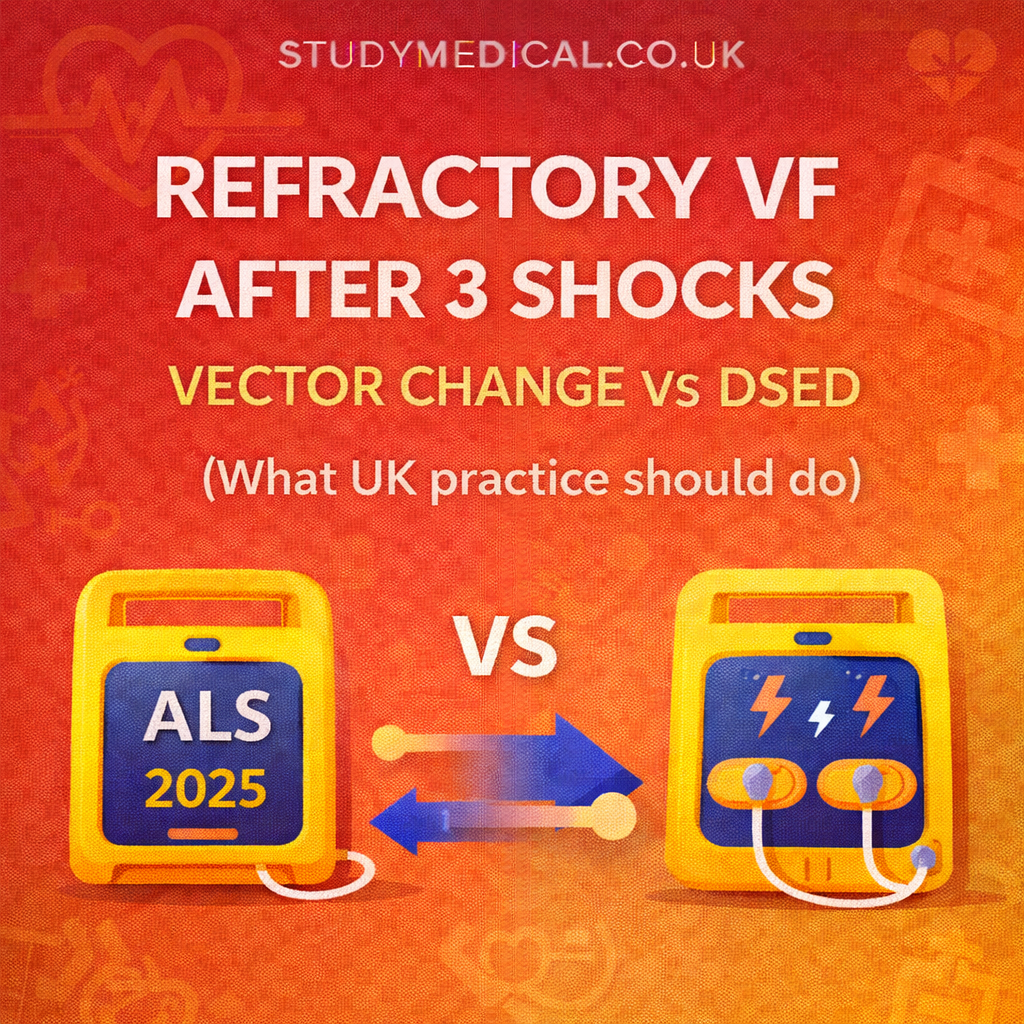
Standard paediatric defibrillation remains 4 J/kg for the initial shocks, with a ceiling linked to adult defibrillator limits. In refractory VF/pVT, the energy can be increased stepwise to 8 J/kg, up to a maximum of 360 J. If a child achieves ROSC and then returns to a shockable rhythm, the guidance advises using the previously successful energy dose.
The standard algorithm also states that adrenaline and amiodarone are given immediately after the third shock, with a second dose after the fifth shock if the rhythm remains shockable.
A particularly exam-friendly nuance appears in the ECG-monitored child already attached to a defibrillator with a witnessed shockable rhythm. In that specific scenario, the guideline allows up to three stacked shocks. If the child remains in a shockable rhythm after those stacked shocks, CPR is restarted, and adrenaline plus amiodarone are then given after the fifth shock, with a second amiodarone dose after the seventh shock.
Pad positioning is also addressed more clearly. Anteroposterior placement may be more practical in smaller children where pad overlap is a concern, while anterolateral positioning is preferred in larger children because it interrupts compressions less.
Special circumstances: where the 2025 update is strongest
One of the most useful changes in the 2025 guidance is how much more explicit it is about special circumstances. This is highly relevant both to real practice and to SBA questions.
Septic shock
The guideline advises obtaining cultures and PCR where possible, but importantly not delaying treatment: start broad-spectrum antibiotics within 1 hour after initial ABCDE management. If shock persists despite fluids and vasoactive support, or if the child has adrenal insufficiency or relevant medication exposure, hydrocortisone 1–2 mg/kg should be considered.
Pulmonary embolism
PE is now addressed much more directly in paediatric guidance. In cardiac arrest due to suspected PE, the guideline advises considering alteplase 0.3–0.5 mg/kg IV over 2 minutes, repeatable after 15 minutes, alongside senior specialist input and consideration of extracorporeal support or embolectomy where available.
Traumatic cardiac arrest
For traumatic arrest, the guidance is very clear that clinicians should prioritise reversible causes using HOTT: Hypotension, Oxygenation, Tension pneumothorax, and cardiac Tamponade. In cardiac arrest, treating these causes either takes priority over, or must run alongside, chest compressions and adrenaline. Unless there is a strong suspicion of a primary shockable rhythm, HOTT takes priority over AED attachment.
Major haemorrhage
In severe blood loss, the guideline recommends a strategy focused on improving coagulation and using tranexamic acid as early as possible, and within 3 hours, in children who require transfusion after trauma or who have life-threatening haemorrhage. The recommended loading dose is 15–20 mg/kg IV, followed by infusion.
Electrolyte disorders
Hyperkalaemia is another area with very specific exam-style wording. In cardiac arrest caused by severe hyperkalaemia, the guideline recommends rapid-acting insulin 0.1 unit/kg with 10% glucose 5 mL/kg as an IV bolus, plus beta-2 agonist therapy and ongoing potassium-lowering strategies. One especially important line is that calcium should not be used in children in cardiac arrest for hyperkalaemia.
The guideline also includes a specific strategy for severe hypokalaemia in cardiac arrest, recommending 1 mmol/kg potassium up to 30 mmol, given rapidly and repeated as needed until the potassium rises above 2.5 mmol/L.
Why does this matter for FRCEM SBA revision?
For FRCEM SBA, paediatric resuscitation questions rarely reward vague familiarity. They usually test the specific decision points: when to stop repeated intubation attempts, when to move to IO access, what fluid bolus to use, when adrenaline and amiodarone are given in shockable arrest, when stacked shocks apply, or how traumatic cardiac arrest differs from medical cardiac arrest.
That makes the 2025 update especially valuable for revision. The broad algorithm is still recognisable, but the new marks are in the finer detail: earlier oxygenation rescue, structured vasoactive choice, clearer shockable-rhythm sequencing, and more explicit management of special circumstances.
Key takeaway
The biggest mistake with paediatric resuscitation revision is assuming “nothing much has changed”. The 2025 RCUK guidance keeps the core structure of paediatric life support, but it adds sharper, more exam-relevant recommendations around airway strategy, shock management, refractory shockable arrest, trauma, PE, sepsis and metabolic emergencies. For candidates preparing for the FRCEM SBA, these are exactly the kinds of updates that can turn a near-miss into a straightforward mark.
References
Resuscitation Council UK. Paediatric Life Support (basic and advanced). 2025. https://www.resus.org.uk/professional-library/2025-resuscitation-guidelines/paediatric-basic-life-support-guidelines?
Resuscitation Council UK. Executive summary of the main changes since the 2021 Guidelines. 2025. https://www.resus.org.uk/professional-library/2025-resuscitation-guidelines/executive-summary-main-changes-2021-guidelines?
European Resuscitation Council. Guidelines 2025. https://www.erc.edu/science-research/guidelines/guidelines-2025/guidelines-2025-english/