The 20-second takeaway
If VF/pVT persists after 3 shocks:
- Fix basics first: high-quality CPR, minimal pauses, oxygen safety, correct antero-lateral pad position and good pad contact/impedance. (resus.org.uk)
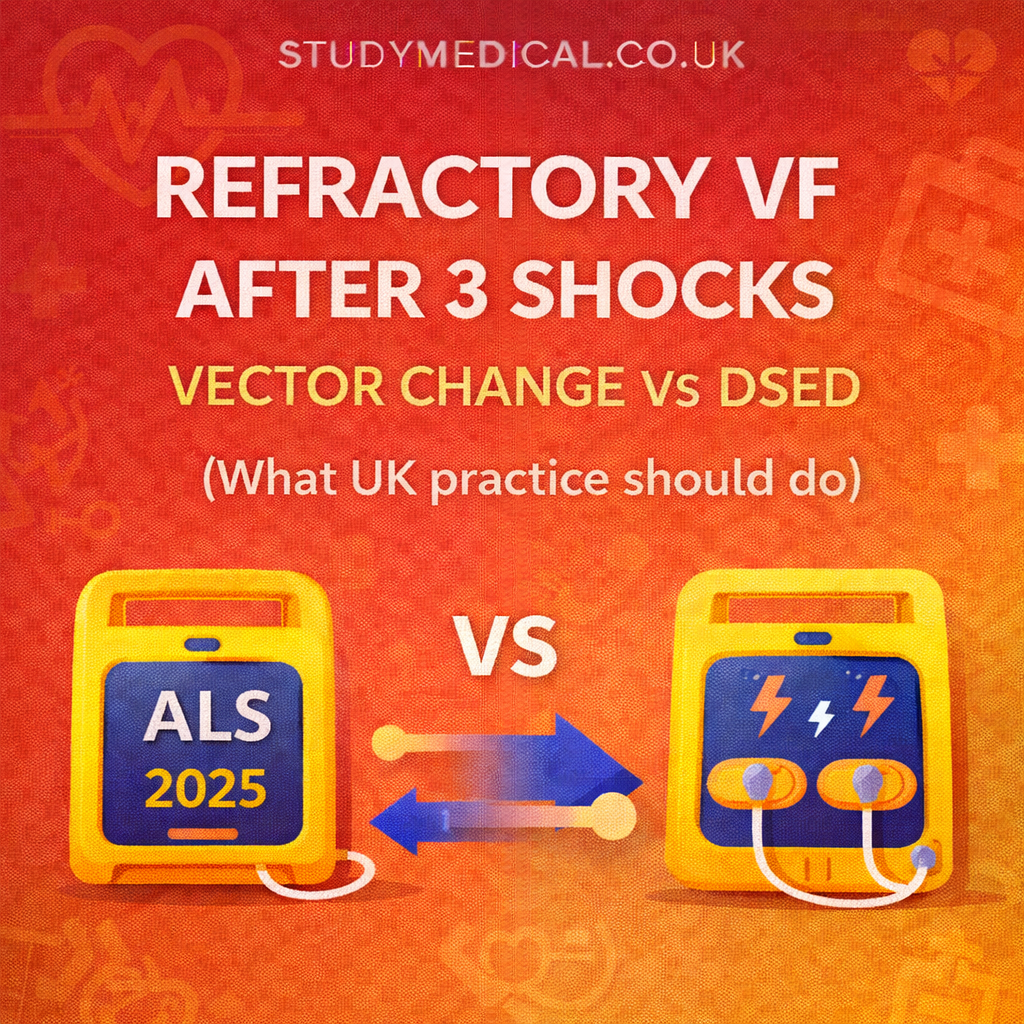
- UK default escalation: vector change (typically antero-posterior pad placement) for the next shock cycle. (resus.org.uk)
- DSED/DSD: ILCOR says it may be considered, but RCUK 2025 does not recommend routine use (practical challenges + limited evidence). (costr.ilcor.org)
What counts as “refractory VF”?
RCUK 2025 defines refractory VF as continuous VF after three consecutive shocks. (resus.org.uk)
Important nuance: “refractory” in this context is a workflow trigger (after shock 3), not a new rhythm diagnosis. Your next move is a defibrillation strategy change without forgetting the standard ALS package (CPR quality, drugs per algorithm, reversible causes, etc.).
Why pad placement suddenly matters more than ever
Before you reach for “new tricks”, RCUK is very explicit: antero-lateral is the initial pad position of choice, and the lateral/apical pad is often placed too anteriorly. RCUK spells out that it should be directly below the armpit in the mid-axillary line. (resus.org.uk)
RCUK also highlights practical ways to optimise transthoracic impedance when escalating (e.g., shaving the pad area if needed, using a fresh set of pads when changing position). (resus.org.uk)
What changed in 2025: ILCOR CoSTR now suggests vector change or DSED
ILCOR’s 2025 CoSTR executive summary states that double sequential external defibrillation (DSED) or vector change defibrillation are now suggested for VF refractory to 3 consecutive shocks.
The more detailed ILCOR evidence review (ALS Task Force) recommends that either strategy may be considered after ≥3 consecutive shocks, and adds a good practice statement: if DSED is used, use a protocol where a single operator activates the defibrillators sequentially (not simultaneously). (costr.ilcor.org)
So internationally: vector change and DSED enter the same “consider” bucket after shock 3.
What UK practice should do: RCUK 2025 prioritises vector change and does not recommend routine DSED
RCUK 2025 Adult ALS guidance is very clear on the UK-facing approach:
1) Vector change is explicitly recommended to consider after 3 failed shocks
For refractory VF (after three shocks), having ensured correct antero-lateral pad positioning, RCUK advises defibrillation vector change by using an alternative pad position (e.g. antero-posterior). It even provides choreography: after the third failed shock, prepare to place a fresh set of pads AP at the next rhythm check. (resus.org.uk)
RCUK also gives precise AP placement landmarks (anterior pad left of sternum, avoid breast tissue; posterior pad same height, medial to left scapula). (resus.org.uk)
2) DSED/DSD is discussed—but not recommended routinely
RCUK describes dual/double sequential defibrillation (DSD) as AL + AP pads with two shocks in close succession, but states: because of practical challenges (two defibs) and limited evidence, RCUK does not recommend routine use. (resus.org.uk)
Bottom line for the UK ED exam answer:
After 3 shocks → vector change (AP pads) is the guideline-supported escalation; routine DSED is not.
Vector change in real life: how to do it without trashing CPR quality
Vector change is attractive because it’s simple, cheap, and (done well) doesn’t add much pause time.
Step-by-step (a practical ED script)
At the end of the third unsuccessful shock cycle:
- Team lead: “We’re refractory VF—prepare vector change. Keep compressions going.” (resus.org.uk)
- Pads: Apply a fresh set of pads in antero-posterior position during compressions, timed to avoid a prolonged peri-shock pause. (resus.org.uk)
- Impedance: If pad contact is poor (sweat, hair), dry/shave quickly where necessary. (resus.org.uk)
- Energy: Escalate shock energy if your defibrillator allows and prior shocks have failed. (resus.org.uk)
- Deliver next shock with the new vector at the next rhythm check, then immediately resume compressions.
UK exam wording to copy
- “Ensure correct antero-lateral pad placement, then change vector to antero-posterior after 3 failed shocks.”
That matches RCUK language closely. (resus.org.uk)
What is DSED/DSD, and why is it controversial?
Double sequential external defibrillation (DSED) (often called DSD in UK documents) uses:
- Two defibrillators
- Two pad vectors (commonly one AL set and one AP set)
- Two shocks delivered in rapid sequence (not simultaneous), ideally triggered by one operator to avoid coordination errors. (costr.ilcor.org)
Why people like it
ILCOR’s evidence synthesis (largely driven by the DOSE-VF trial) reports improved outcomes for DSED vs standard defibrillation in out-of-hospital refractory VF:
- Survival to discharge: 30.4% vs 13.3% (adjusted RR 2.21) (costr.ilcor.org)
- Favourable functional outcome (mRS 0–2): 27.4% vs 11.2% (adjusted RR 2.21) (costr.ilcor.org)
- Higher VF termination and ROSC rates than standard defib in that trial dataset (costr.ilcor.org)
Vector change alone also showed improved outcomes vs standard in the same evidence base, though effects were less consistently “statistically significant” across all endpoints. (costr.ilcor.org)
Why RCUK doesn’t recommend routine use (yet)
RCUK explicitly cites:
- Practical challenges (needing two defibs, coordination)
- Limited evidence for efficacy in a way that justifies routine adoption across UK systems (resus.org.uk)
ILCOR also highlights uncertainty and implementation issues: evidence is dominated by a single cluster RCT, sample size short of plan, no clear proof which strategy is superior, and there’s no standardised DSED method across systems. (costr.ilcor.org)
Translation for UK clinicians: DSED may exist in some services under governance / specialist pathways, but for typical ED ALS practice (and for FRCEM SBA), vector change is your clean, guideline-aligned move.
A UK-ready algorithm for “VF after 3 shocks” (what the examiner wants)
Use this as a mental checklist. If you hit these points, you’ll rarely drop marks:
- Confirm it’s shockable (VF/pVT).
- High-quality CPR + minimise peri-shock pause. (resus.org.uk)
- Optimise defib basics:
- Correct antero-lateral pad placement (apical pad truly lateral, mid-axillary). (resus.org.uk)
- Consider energy escalation with failed shocks. (resus.org.uk)
- After 3 failed shocks: vector change to antero-posterior (fresh pads; impedance optimisation). (resus.org.uk)
- Don’t claim routine DSED as UK standard—RCUK doesn’t recommend it routinely. (resus.org.uk)
- Continue full ALS: drugs per algorithm, reversible causes, consider advanced options (e.g., eCPR where available) based on local pathways.
FRCEM SBA pearls (the classic “gotchas”)
- Pearl 1: “Refractory VF” in RCUK = still VF after 3 shocks, not “after 5 shocks” or “after amiodarone”. (resus.org.uk)
- Pearl 2: The first corrective action is often pad placement (mid-axillary apical pad). (resus.org.uk)
- Pearl 3: Vector change is specifically signposted by RCUK after shock 3. (resus.org.uk)
- Pearl 4: If asked “Which is recommended routinely in UK guidance?” → not DSED/DSD. (resus.org.uk)
- Pearl 5: If a question asks what ILCOR suggests you may consider → vector change or DSED.
FAQ (SEO + exam revision)
Is DSED the same as vector change?
No. Vector change = change pad position to alter current pathway (commonly AL → AP). DSED/DSD = two defibrillators delivering two sequential shocks using two vectors (often AL + AP). (resus.org.uk)
Does RCUK 2025 recommend DSED routinely?
No—RCUK explicitly says it does not recommend routine use due to practical challenges and limited evidence. (resus.org.uk)
What does ILCOR 2025 say?
ILCOR 2025 suggests either vector change or DSED may be considered for VF refractory to 3 shocks.
When should I physically switch to AP pads?
RCUK suggests that after the failed third shock, you should prepare to place a fresh set of AP pads at the following rhythm check (i.e., don’t create a long pause; choreograph it). (resus.org.uk)
How this shows up in the StudyMedical FRCEM SBA question bank
Expect questions that make you choose between:
- “Continue standard shocks” vs “vector change after 3 shocks”
- “DSED is recommended” vs “DSED not routinely recommended by RCUK”
- “Pad position doesn’t matter” vs “mid-axillary lateral pad placement is essential”
If you’re building your revision around rapid, repeated exposure, this topic is perfect for:
- Algorithm SBAs (next best step after shock 3)
- Human factors SBAs (minimising peri-shock pause while changing pads)
- Governance SBAs (why DSED isn’t routine UK practice despite ILCOR)
Disclaimer: This article is for FRCEM/clinical education and summarises international and UK guideline statements. Always follow your local Resuscitation Council guidance, Trust policy, and resuscitation officer governance.