Why CPR-induced consciousness is now a big SBA topic
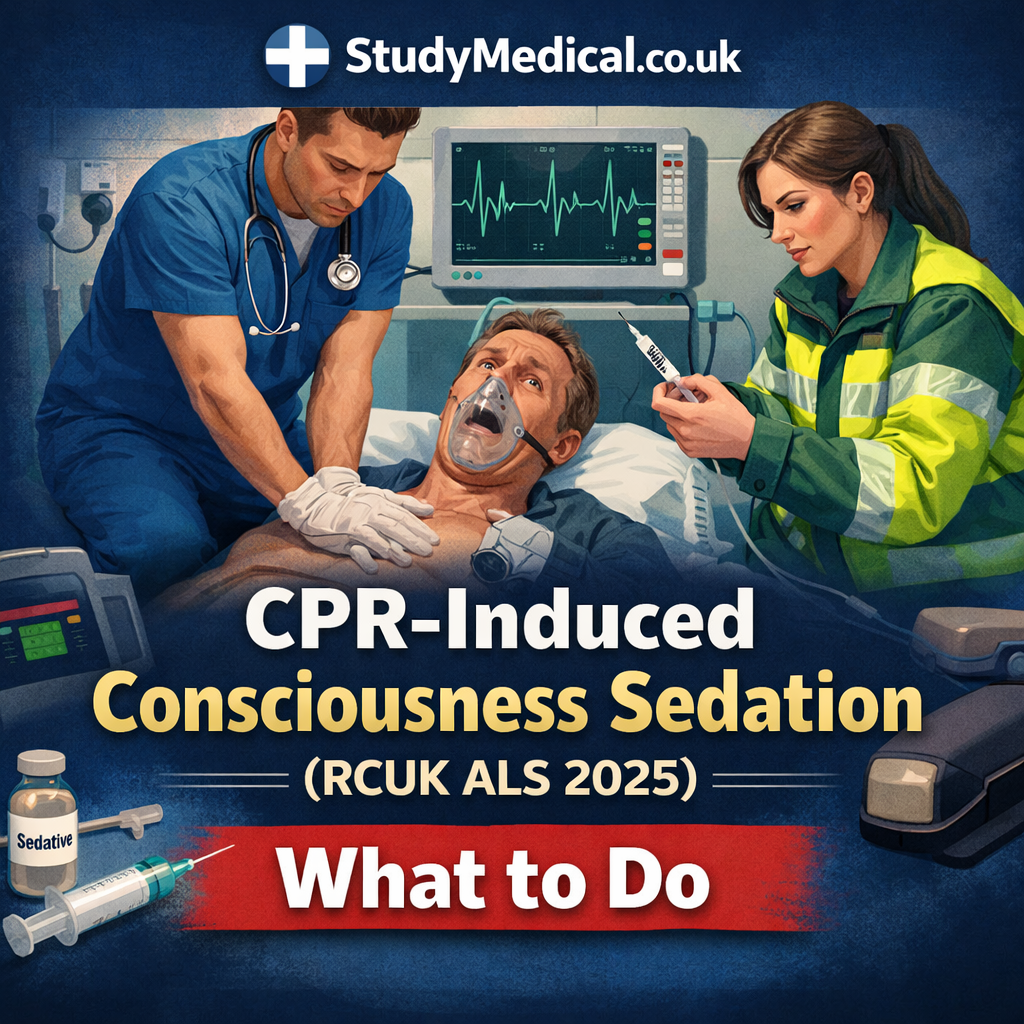
CPR-induced consciousness (sometimes “CPRIC”) is one of those rare resus phenomena that’s more frequently reported now—and it can derail a team: compressions get interrupted, rhythm checks become chaotic, and safety risks go up.
RCUK 2025 Adult ALS now explicitly addresses CPR-induced consciousness and the need for sedation and analgesia, which is exactly why it’s appearing in exam questions.
What is CPR-induced consciousness?
RCUK describes cardiopulmonary resuscitation–induced consciousness (without ROSC) as uncommon but increasingly reported.
In practice, it can look like:
- Eye opening, grimacing, moaning
- Purposeful movements (grabbing at staff, pushing hands away)
- Agitation or apparent “fighting” the resuscitation
Key concept: it can occur without ROSC. The patient may lose consciousness again if compressions stop—so panic-pauses are dangerous.
The FRCEM SBA “one-liner” answer
If a patient appears conscious during CPR, you do not stop CPR.
You continue high-quality CPR, manage safety, and consider small doses of sedative and/or analgesic drugs to prevent pain and distress.
Stepwise approach: what UK practice should do in the moment
1) Don’t be tricked into stopping compressions
The biggest harm from CPRIC is interruptions. Treat the agitation as a team/human-factors problem, not a reason to abandon ALS structure.
What to do instead
- Keep to planned 2-minute cycles
- Keep peri-shock pauses minimal
- Assign a “CPRIC safety” role (hands/arms, lines, tube, pads)
(Examiner logic: “continue CPR with minimal interruption” always beats “pause to check a pulse because they moved”.)
2) Rapidly consider “is this ROSC?”—but only at appropriate times
RCUK reminds clinicians not to stop compressions based on a single sign; use a combination of clinical/physiological features before stopping for rhythm analysis/pulse check.
If you have an arterial line, a sudden pulsatile waveform plus a sharp ETCO₂ rise and purposeful movement should trigger a structured ROSC check at the rhythm check—not random pauses.
3) Sedate/analgesia: small doses, titrated, protocolised
RCUK states that rescuers may consider sedative or analgesic drugs (or both) in small doses to prevent pain and distress in patients who are conscious during CPR.
RCUK also notes:
- The optimal regimen is uncertain
- Regimens may be based on those used in critically ill patients and local protocols
- Examples include small doses of fentanyl, ketamine and/or midazolam
Practical SBA framing: the “correct” answer is rarely a specific dose; it’s the principle:
- small, titrated sedative/analgesic dosing
- don’t interrupt CPR
- don’t delay defibrillation
4) The single most tested “what not to do”
RCUK is explicit:
Neuromuscular blocking drugs alone should not be given to conscious patients.
That line is pure SBA gold.
If paralysis is needed for another reason (e.g., airway control), the safe principle is: do not paralyse unless you have provided sedation/analgesia appropriately (and you still do not sacrifice CPR quality to do it).
“What not to do” list (classic SBA distractors)
These are the answer options examiners love:
- Stop compressions because the patient is moving/talking
→ Wrong. CPRIC can occur without ROSC; interruptions reduce survival chances. - Give rocuronium/suxamethonium “to stop them fighting” (without sedation)
→ Wrong. RCUK explicitly warns against neuromuscular blockers alone. - Repeated pulse checks / prolonged rhythm analysis
→ Wrong. Keep to structured checks; minimise hands-off time. - Delay defibrillation to “get them sedated first”
→ Wrong. Sedation must not become the new reason shocks are late. - Assume it’s a seizure and treat with a big benzo dose as the first move
→ Usually wrong in exam logic: manage CPR quality + consider small titrated sedation/analgesia (and reassess).
Why guidelines say “small doses” (and why SBAs care)
The evidence base isn’t huge. ILCOR’s international consensus documents also describe using very small doses of sedative/analgesic medication where feasible to reduce pain and distress during CPRIC.
Observational work and scoping reviews highlight that CPRIC can cause rescuer distress and lead to CPR interruptions, while drug use varies widely between systems.
So SBAs usually test:
- recognition of CPRIC
- avoidance of harmful interruptions
- “don’t paralyse alone”
- “use small titrated sedation/analgesia per local protocol”
A simple “CPRIC during ALS” mental algorithm
Use this as your on-the-spot structure (and your exam structure):
- Continue CPR (don’t be pulled into random pauses)
- Safety + role allocation (protect staff, protect airway/lines/pads)
- At rhythm check: consider ROSC only if multiple signs (e.g., ETCO₂ jump + arterial waveform + purposeful movement)
- If ongoing arrest: consider small-dose sedation/analgesia (fentanyl/ketamine/midazolam options under local protocol)
- Never: neuromuscular blocker alone
- Debrief after (CPRIC is psychologically taxing and operationally disruptive—teams learn a lot from reviewing it)
How this appears in FRCEM SBA stems
Expect stems like:
- “During CPR the patient opens their eyes and grabs the rescuer…”
- “Agitation is causing repeated pauses in compressions…”
- “Someone suggests giving rocuronium to stop movement…”
- “ETCO₂ rises and the patient moves—what next?”
Correct answers usually centre on:
- maintain CPR quality
- structured ROSC assessment at rhythm checks
- consider small-dose sedation/analgesia
- avoid paralysis without sedation
FAQ
Is CPR-induced consciousness the same as ROSC?
Not necessarily. RCUK describes CPRIC as consciousness without ROSC.
Which drugs does RCUK 2025 mention?
RCUK says the optimal regimen is uncertain, but gives examples aligned to local protocols: small doses of fentanyl, ketamine and/or midazolam.
Can I just paralyse the patient so CPR is easier?
Not on its own. RCUK explicitly states neuromuscular blocking drugs alone should not be given to conscious patients.