Why this is suddenly “must-know” for FRCEM SBA
RCUK 2025 includes a dedicated post-resuscitation care guideline plus a post-ROSC algorithm, and the Adult ALS algorithm now explicitly prompts immediate post-ROSC targets (oxygenation, ventilation, blood pressure, temperature control). That combination is perfect for SBA writers because it produces clear numerical targets and rule-based decision points. (resus.org.uk)
The 20-second SBA answer (targets you should memorise)
Immediately after ROSC (Adult ALS algorithm prompt):
- Aim SpO₂ 94–98% and normal PaCO₂
- SBP > 100 mmHg
- 12-lead ECG, identify/treat cause, temperature control
Then the post-resuscitation care guideline expands the “numbers” into ICU-grade targets:
- Oxygen: titrate to SpO₂ 94–98% or PaO₂ 10–13 kPa (75–100 mmHg) once reliable; avoid hypoxaemia and hyperoxaemia (resus.org.uk)
- Ventilation: target normocapnia PaCO₂ 4.7–6.0 kPa (35–45 mmHg); use lung-protective VT 6–8 mL/kg ideal body weight (resus.org.uk)
- Blood pressure: SBP > 100 mmHg or MAP > 60–65 mmHg; avoid hypotension (resus.org.uk)
- Prognostication: delay and use a multimodal approach, typically at ≥72 h with confounders excluded (resus.org.uk)
If you can reproduce those in an SBA, you’ll usually score.
Oxygenation after ROSC (what “titrate oxygen” actually means)
1) Immediately after ROSC: start high, then titrate down
RCUK advises using 100% (or maximum available) inspired oxygen immediately after ROSC until you can reliably measure SpO₂ (or obtain ABGs), then titrate. (resus.org.uk)
2) The target range (and the ABG equivalent)
Once reliable:
- SpO₂ 94–98%
- or PaO₂ 10–13 kPa (75–100 mmHg) (resus.org.uk)
3) What the examiner is really testing: avoid both extremes
RCUK explicitly says to avoid hypoxaemia (PaO₂ < 8 kPa / 60 mmHg) and avoid hyperoxaemia after ROSC. (resus.org.uk)
SBA traps
- “Keep FiO₂ 1.0 for the first hour regardless” → wrong once oxygenation can be measured; you should titrate to the target range. (resus.org.uk)
- “Aim SpO₂ 100%” → wrong; the target is 94–98%. (resus.org.uk)
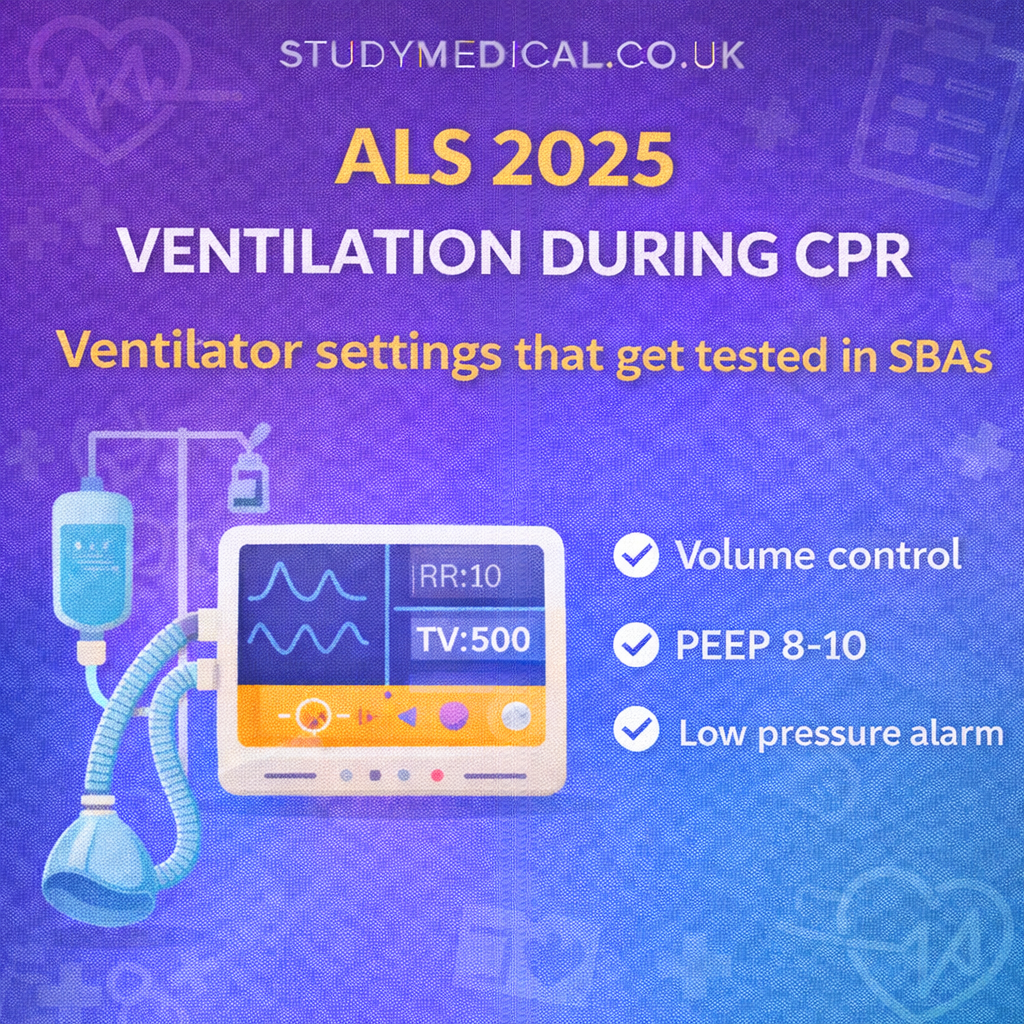
Ventilation after ROSC (PaCO₂ targets + protective strategy)
1) Measure properly
RCUK recommends arterial blood gases and using end-tidal CO₂ in mechanically ventilated patients. (resus.org.uk)
2) The PaCO₂ target that gets tested
Target normocapnia:
- PaCO₂ 4.7–6.0 kPa (35–45 mmHg) (resus.org.uk)
RCUK also flags special situations:
- If hypothermic (accidental or treated), monitor PaCO₂ frequently because hypocapnia may occur, and be consistent about temperature-corrected vs uncorrected gases. (resus.org.uk)
3) Lung-protective ventilation
Use a lung protective strategy:
- VT 6–8 mL/kg ideal body weight (resus.org.uk)
SBA traps
- “Hyperventilate to blow off CO₂” → wrong; you’re targeting normocapnia, not low CO₂. (resus.org.uk)
- “Use big tidal volumes for ‘better oxygenation’” → wrong; stick to protective VT. (resus.org.uk)
Blood pressure targets after ROSC (SBP vs MAP, and how to support it)
RCUK’s key point is simple: avoid hypotension.
The targets
- Aim SBP > 100 mmHg or
- MAP > 60–65 mmHg (resus.org.uk)
How RCUK expects you to get there (SBA-relevant themes)
- Use arterial line monitoring for continuous BP measurement. (resus.org.uk)
- Maintain perfusion with fluids and vasopressors/inotropes tailored to physiology (RCUK explicitly mentions fluids plus noradrenaline and/or dobutamine, depending on need). (resus.org.uk)
- Perform echocardiography early to assess myocardial dysfunction / underlying pathology. (resus.org.uk)
SBA traps
- “Permissive hypotension post-ROSC” → wrong; hypotension is specifically to be avoided and targets are given. (resus.org.uk)
- “Steroids routinely after arrest” → RCUK says do not give steroids routinely. (resus.org.uk)
Temperature control (because neuroprognostication depends on it)
RCUK’s post-resuscitation guidance emphasises fever prevention:
- Actively prevent fever by targeting ≤ 37.5°C in comatose patients after ROSC. (resus.org.uk)
- Prevent active fever for 36–72 hours in comatose post-cardiac arrest patients. (resus.org.uk)
- If the patient is already mildly hypothermic (32–36°C) after ROSC, do not actively warm to normothermia. (resus.org.uk)
Why this matters for SBAs: prognostication is unreliable if hypothermia and sedation confound the exam (RCUK repeatedly stresses excluding confounders).
Neuroprognostication 2025 (the “72-hour + multimodal + 2 signs” rule)
Core principle
RCUK states:
- Use multimodal neuroprognostication (clinical exam + electrophysiology + biomarkers + imaging). (resus.org.uk)
- No single predictor is 100% accurate, and when predicting poor outcome you want high specificity to avoid false pessimism. (resus.org.uk)
- Consider prognostication when the patient is not awake/obeying commands at 72 h or later after ROSC, with confounders excluded. (resus.org.uk)
Confounders (worth listing in an SBA explanation)
RCUK’s neuroprognostication algorithm highlights major confounders such as:
- analgo-sedation, neuromuscular blockade, hypothermia, severe hypotension, hypoglycaemia, sepsis, and metabolic/respiratory derangements.
Poor outcome: “two or more unfavourable signs”
In an unconscious patient (motor score ≤5) at ≥72 h with confounders excluded, poor neurological outcome is very likely when at least TWO unfavourable signs are present, including:
- No pupillary and corneal reflexes at ≥72 h
- Bilaterally absent N20 SSEP wave at ≥24 h
- Suppression or burst-suppression on EEG at ≥24 h (RCUK also describes “highly malignant” EEG patterns as poor prognostic indicators) (resus.org.uk)
- NSE > 60 mcg/L at 48 h and/or 72 h
- Status myoclonus within 72 h
- Diffuse and extensive hypoxic-ischaemic injury on brain CT (any time) or MRI (after 2 days)
RCUK also notes practical details like using a pupillometer when available, and doing serial NSE sampling (24/48/72 h) to look at trends and reduce confounding from haemolysis.
Good outcome: “favourable signs”
RCUK’s algorithm also lists “favourable signs” associated with good neurological outcome being likely, such as:
- GCS-M 4 or 5
- Continuous, normal-voltage EEG background within 72 h
- NSE ≤ 17 mcg/L within 72 h
- No diffusion changes on MRI at 2–7 days
SBA trap: Early “doom” based on a single sign (e.g., one absent reflex while still sedated) is wrong. The guideline approach is delayed, multimodal, and confounder-aware. (resus.org.uk)
The ED–ICU handover checklist (what examiners want you to say)
When a stem says “ROSC achieved—what’s next?”, the best answers usually bundle:
1. ABCD reassessment + ventilation/oxygen targets
- SpO₂ 94–98% (PaO₂ 10–13 kPa)
- PaCO₂ 4.7–6.0 kPa, protective VT 6–8 mL/kg IBW (resus.org.uk)
2. Haemodynamics
- SBP >100 or MAP >60–65, arterial line, echo, fluids + vasopressor/inotrope as needed (resus.org.uk)
3. Temperature
- Prevent fever (≤37.5°C) and continue for 36–72 h if comatose (resus.org.uk)
4. 12-lead ECG + cause pathway
- Immediate cath lab for clear STEMI / high suspicion; consider CT head-to-pelvis where relevant (resus.org.uk)
5. Neuroprognostication plan
- Daily neuro exams, EEG/SSEP/biomarkers/imaging; delay definitive prognostication until ≥72 h with confounders excluded (resus.org.uk)
FAQ
What are the post-ROSC oxygen targets in RCUK 2025?
Titrate to SpO₂ 94–98% once reliable, or PaO₂ 10–13 kPa; avoid both hypoxaemia and hyperoxaemia. (resus.org.uk)
What PaCO₂ should I aim for after ROSC?
Normocapnia: PaCO₂ 4.7–6.0 kPa (35–45 mmHg), using ABGs and ETCO₂ (if ventilated). (resus.org.uk)
What BP target gets tested in SBAs?
RCUK states SBP >100 mmHg or MAP >60–65 mmHg, with emphasis on avoiding hypotension and using arterial line monitoring. (resus.org.uk)
When should neuroprognostication be performed?
In general, when the patient is not obeying commands at ≥72 h after ROSC, confounders excluded, using a multimodal strategy (no single test). (resus.org.uk)