The Resuscitation Council UK (RCUK) 2025 Resuscitation Guidelines were published in October 2025 and include updated Adult Advanced Life Support (ALS) guidance for UK practice. The headline message for exam revision is reassuring: the core ALS algorithm is unchanged from 2021, but the 2025 update places clearer emphasis on a few practical details that are easy to miss in SBAs—especially ventilation quality, defibrillator pad positioning, and what to do after three failed shocks. (Resuscitation Council UK)
If you’re using a question bank for FRCEM SBA revision, this is exactly the sort of “small change / big marks” update that tends to appear in vignette-based questions.
The big picture: what the 2025 ALS guidance is (and isn’t)
RCUK’s Adult ALS 2025 guidance is aligned with the European Resuscitation Council (ERC) Guidelines 2025 and is written for UK healthcare systems. (Resuscitation Council UK)
Key point for FRCEM SBA: RCUK explicitly states there are no major changes in Adult ALS compared with 2021—but examiners can still test the emphasis points and the exact wording around defibrillation, ventilation and post-ROSC care. (Resuscitation Council UK)
What hasn’t changed (core ALS priorities still win marks)
The 2025 guidance retains the “classic” Adult ALS priorities:
- Early recognition + early ALS
- High-quality chest compressions with minimal interruption
- Early defibrillation where indicated
- Prompt identification and treatment of reversible causes
These remain the backbone of the RCUK Adult ALS algorithm. (Resuscitation Council UK)
What is updated or emphasised in 2025 (high-yield for SBAs)
1) Ventilation matters more than you think (and is more explicitly stressed)
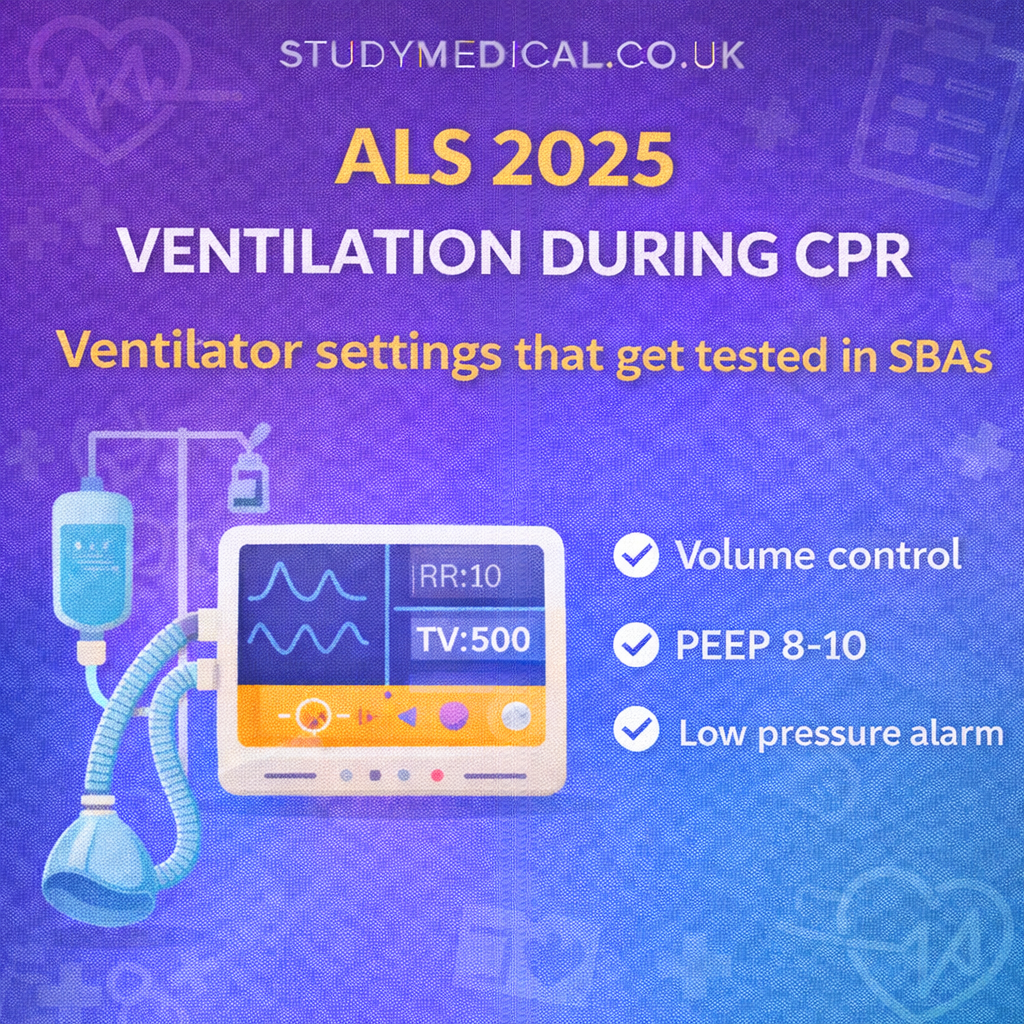
RCUK flags a greater emphasis on effective oxygenation and ventilation during ALS. (Resuscitation Council UK)
Practical SBA angles include:
- When an advanced airway is in place, avoid “random bagging”: use controlled ventilation and keep compressions continuous where appropriate.
- If using a ventilator during CPR, RCUK gives specific settings (commonly tested because they’re precise): volume control, tidal volume 6–8 mL/kg predicted ideal body weight, rate 10/min, inspiratory time 1–2 s, FiO₂ max, PEEP 0–5 cmH₂O, and appropriate alarm/trigger settings. (Resuscitation Council UK)
2) Defibrillator pad placement: a “small detail” that’s now explicitly examinable
RCUK places greater emphasis on correct initial pad placement, specifically: the lateral (apical) pad should sit below the armpit in the mid-axillary line (antero-lateral position). (Resuscitation Council UK)
This is perfect SBA territory because:
- Many candidates place the lateral pad too anteriorly.
- The question stem may describe “pads applied” and ask for the best next step to optimise defibrillation success.
3) Refractory VF after 3 shocks: vector change is the UK-safe answer
RCUK recommends that after three failed shocks in refractory VF/pVT, you should consider defibrillation vector change by switching to an antero-posterior pad position. (Resuscitation Council UK)
RCUK also explicitly states that dual/double sequential defibrillation (DSD) is not recommended routinely (limited evidence + practical challenges). (Resuscitation Council UK)
Worth knowing for nuanced questions: the ILCOR 2025 CoSTR executive summary notes that DSD or vector change defibrillation are now suggested for VF refractory to 3 shocks (international evidence synthesis), but RCUK’s UK-facing guidance still favours vector change rather than routine DSD. In a UK FRCEM SBA, the best answer is usually vector change unless the stem explicitly places you in a specialist protocolled setting.
4) Adrenaline timing remains the same (so it’s a reliable “anchor” in SBAs)
RCUK restates the timing clearly:
- Non-shockable (PEA/asystole): give adrenaline as soon as possible, then every 3–5 minutes
- Shockable (VF/pVT): give the first adrenaline after the 3rd shock, then every 3–5 minutes
(And amiodarone after 3 shocks is reinforced in the algorithm.) (Resuscitation Council UK)
5) Waveform capnography: not just tube confirmation
RCUK emphasises waveform capnography for:
- Confirming tracheal tube placement during CPR
- Monitoring CPR quality
- Using ETCO₂ trends as one indicator of ROSC (but don’t stop compressions based on ETCO₂ alone)
and don’t use a low ETCO₂ alone as the reason to terminate resuscitation. (Resuscitation Council UK)
This is a common SBA trap: the “single-parameter decision” (ETCO₂) is usually the wrong move.
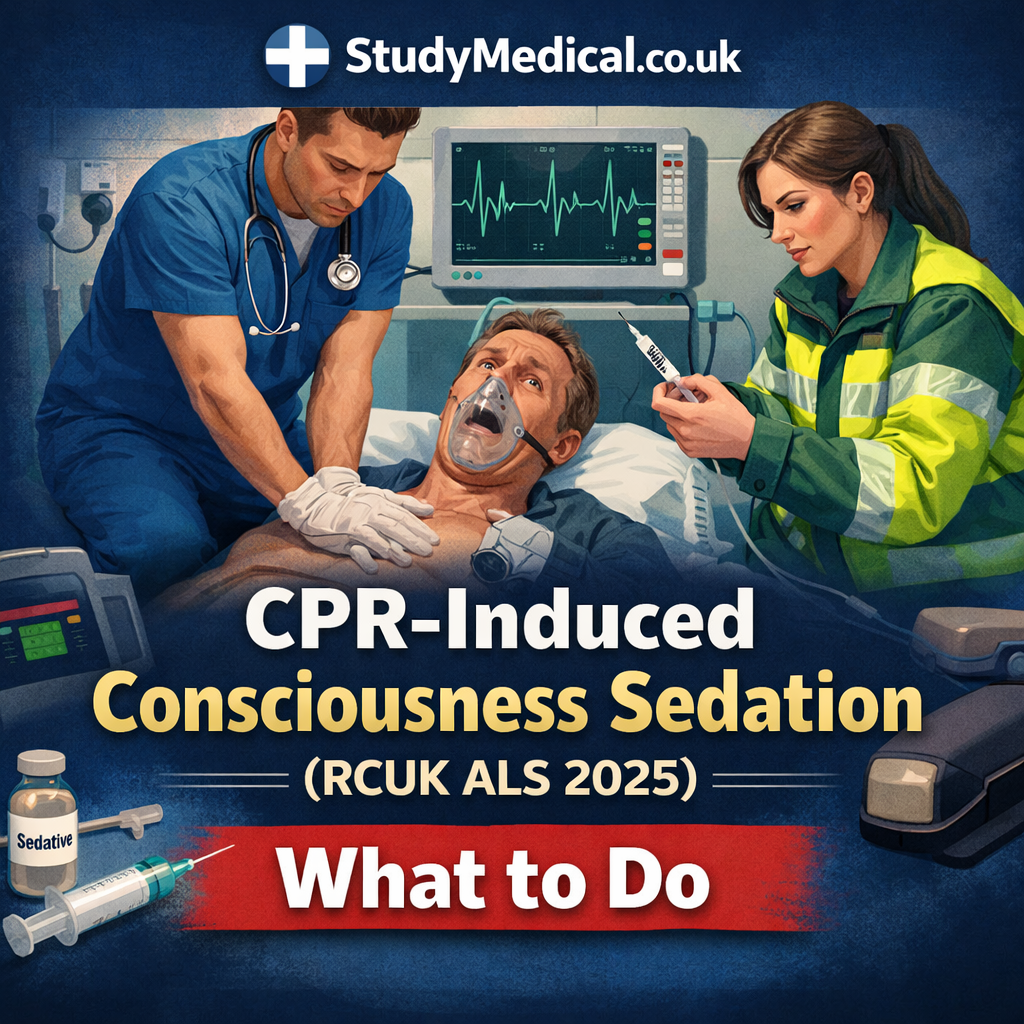
6) CPR-induced consciousness: now explicitly addressed
RCUK includes a dedicated section on CPR-induced consciousness (without ROSC) and suggests:
- Consider small doses of sedative/analgesic drugs to reduce distress/pain
- Do not give neuromuscular blockers alone (paralysis without analgesia/sedation is unsafe)
- The optimal regimen is uncertain; options may include small doses of fentanyl, ketamine and/or midazolam guided by local protocols. (Resuscitation Council UK)
Expect SBA stems like: “patient opens eyes during compressions; what’s most appropriate pharmacological approach?”
7) Devices and “advanced” options: know what’s not routine
RCUK states:
- Mechanical CPR devices: consider only if high-quality manual compressions aren’t practical or compromise rescuer safety (and minimise interruptions during application). (Resuscitation Council UK)
- ECPR: may be considered as rescue therapy for selected IHCA/OHCA when conventional CPR fails, where it can be implemented (i.e., specialist systems). (Resuscitation Council UK)
- REBOA and intra-arrest cooling are not recommended routinely (with narrow exceptions such as severe hyperthermia for cooling). (Resuscitation Council UK)
Reversible causes and “special circumstances”: what’s worth revising
RCUK’s 2025 approach continues to push early recognition and treatment of reversible causes, including explicit permission to prioritise a reversible-cause intervention even if it briefly interrupts compressions (when appropriate). (Resuscitation Council UK)
An example of where evidence synthesis may appear in SBAs: hyperkalaemia. In the ILCOR 2025 CoSTR executive summary, the task force suggests insulin + glucose for hyperkalaemia with cardiac arrest, noting insufficient evidence to recommend for/against calcium in arrest and insufficient evidence for bicarbonate in arrest. This is the kind of “evidence update” that may show up in EBM-flavoured resus questions (though local UK hyperkalaemia protocols still commonly include calcium for membrane stabilisation).
Post-ROSC care: “ALS continues after pulses return”
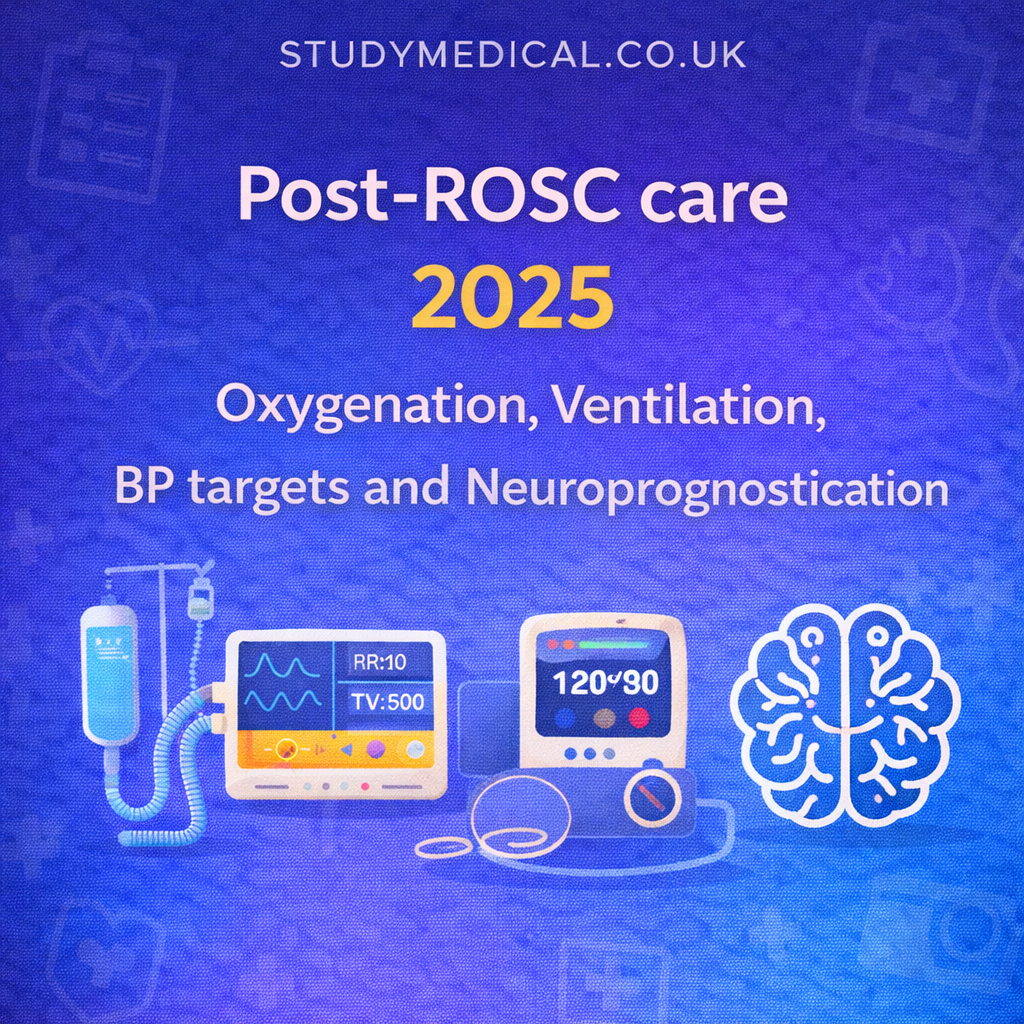
RCUK’s Adult ALS algorithm explicitly lists immediate post-ROSC actions (ABCDE, SpO₂ targets, normocapnia, BP target, ECG, treat cause, temperature control).
The 2025 post-resuscitation care guidance provides exam-friendly targets:
- Titrate oxygen to SpO₂ 94–98% once reliable monitoring/ABG available
- Ventilate to normocapnia
- Aim SBP >100 mmHg or MAP >60–65 mmHg
- Structured pathway including coronary angiography prioritisation for STEMI/suspected occlusion, and broader investigation (e.g., CT) where appropriate (Resuscitation Council UK)
How this shows up in FRCEM SBA stems (and how to beat it)
When you’re revising ALS for SBAs, the easiest marks often come from precision details rather than “CPR + shock + adrenaline” basics. Build practice around stems that test:
- Pad placement wording (mid-axillary “below the armpit”) (Resuscitation Council UK)
- Refractory VF after 3 shocks → vector change to AP (DSD not routine in UK guidance) (Resuscitation Council UK)
- Ventilation strategy once advanced airway in place + ventilator CPR settings (Resuscitation Council UK)
- Capnography interpretation (tube confirmation vs ROSC clue vs termination trap) (Resuscitation Council UK)
- CPR-induced consciousness management (sedation/analgesia; no paralytic alone) (Resuscitation Council UK)
- Post-ROSC targets (SpO₂ 94–98, normocapnia, SBP/MAP targets) (Resuscitation Council UK)
Practical revision tip for StudyMedical users: “algorithm fluency” > rereading PDFs
For ALS, passive reading is inefficient. Your best ROI for FRCEM SBA is:
- One-page algorithm drills (shockable/non-shockable): force yourself to write the next 5 steps from memory.
- Micro-questions on the new emphasis points (pads, ventilation, refractory VF, capnography, post-ROSC targets).
- Error log: every time you miss an ALS SBA, tag it (e.g., defib pads, ETCO₂, post-ROSC). Then re-test those tags weekly.
Disclaimer
This article is for education and exam revision. In clinical practice, follow RCUK guidance, your local Trust resuscitation policies, and specialist advice where indicated.