What Is Quality Improvement & Patient Safety and Why Does It Matter in the ED?
Quality Improvement (QI) is a structured, continuous approach to making care safer, more effective, patient-centred, timely, efficient and equitable. In practice, it means using simple tools (PDSA cycles, run charts, process mapping) to test changes in how your ED works, then measuring whether those changes actually help patients. (Aqua)
Patient safety focuses on preventing avoidable harm caused by healthcare itself: medication errors, delayed treatment, miscommunication, crowding, and all the other failure modes you see on every busy shift. RCEM’s 2021 curriculum makes “participate in and promote activity to improve the quality and safety of patient care” its own Specialty Learning Outcome (SLO 11), explicitly requiring trainees to engage in QI. (RCEM)
For the FRCEM SBA, QI and safety appear as management and professional practice questions: run chart interpretation, PDSA design, human factors around incidents, and how to respond to safety problems in the ED.
How Quality Improvement & Patient Safety Appear in the FRCEM SBA Exam
Typical question angles:
- Picking the most appropriate next step in a QI project (e.g. what to do after a PDSA cycle).
- Distinguishing audit vs QI vs research.
- Interpreting run charts and identifying non-random variation (shift, trend, astronomical point). (NHS England)
- Applying human factors principles to an incident (systems vs individual blame). (RCEM Learning)
- Choosing the best patient safety intervention (e.g. checklists, standardisation, SBAR handover, huddles).
- Understanding measurement for improvement (process vs outcome vs balancing measures). (NHS England)
Common formats:
- Short vignette of a recurring error in the ED → “Which is the best next step in a QI approach?”
- A run chart of door-to-needle time, annotated with interventions → “Which statement about this chart is most accurate?”
- Description of an incident → “Which factor most contributed?” (workload, environment, communication, team culture, etc.).
- Abstract of a “QI project” → is it actually audit, research, or genuine iterative QI?
Mini example scenario
Over three months, 15 serious incidents relate to delayed triage of septic patients. A consultant wants to improve time to first antibiotic. A run chart of door-to-needle times is shown with a new triage pathway introduced at week 6. The question asks which pattern suggests a genuine improvement and what the next PDSA step should be.
Core Concepts You Must Know About Quality Improvement & Patient Safety
Definitions & Key Criteria
- Quality Improvement vs Audit vs Research
- QI: rapid, iterative tests of change (PDSA) to improve a local process.
- Audit: check current practice against a standard; usually “before and after” with a re-audit.
- Research: generate generalisable knowledge, usually with formal ethics and robust methodology. (East of England)
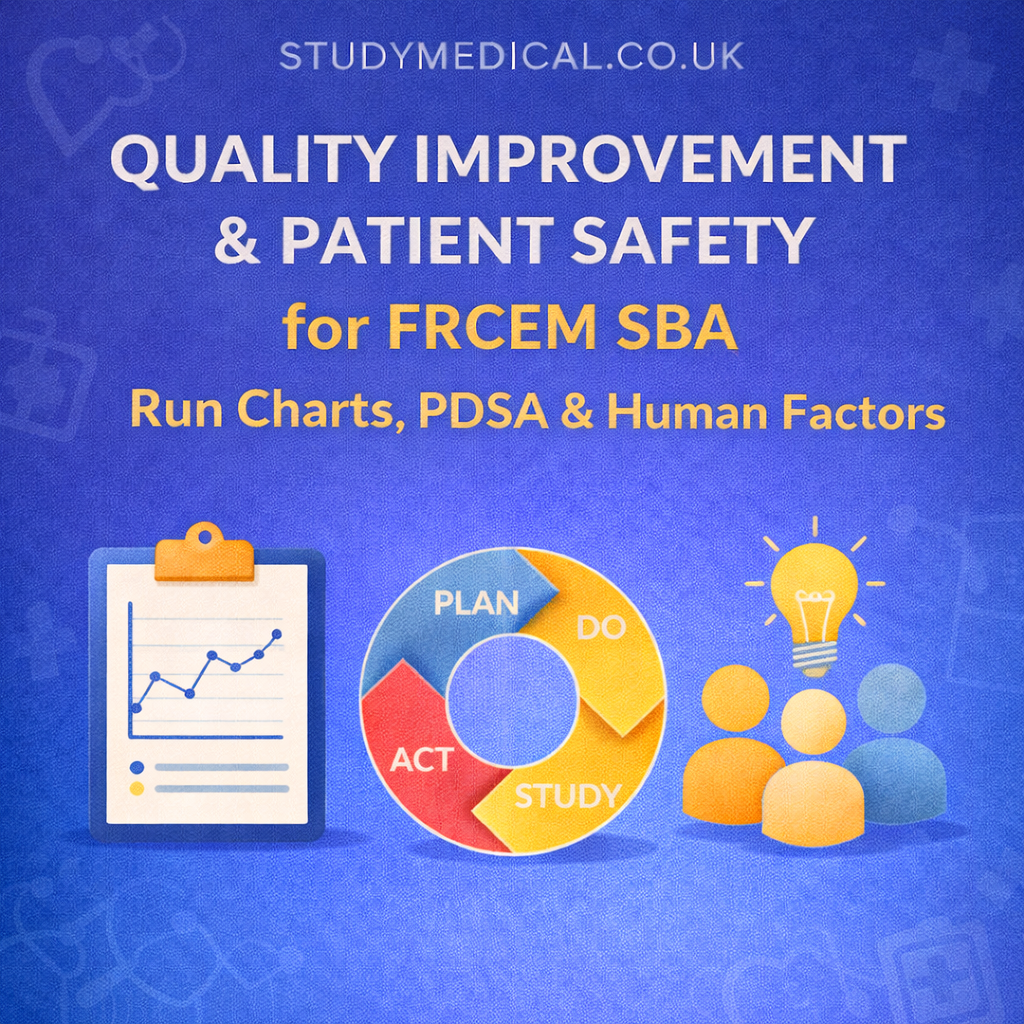
- PDSA Cycle (Plan–Do–Study–Act)
- Plan: define the aim, prediction, measures, and plan the change.
- Do: test on a small scale; collect data.
- Study: compare results with predictions, learn from variance.
- Act: adopt, adapt, or abandon the change; plan the next cycle. (Aqua)
- Run Charts
- Time-ordered plot of a measure (e.g. time to analgesia) with a median line.
- Used to distinguish random (common cause) variation from non-random (special cause) variation using simple rules (shift, trend, too many/few runs, astronomical point). (NHS England)
- Human Factors
- How people, teams, tasks, tools and the environment interact to influence behaviour and performance.
- Focus is on systems design, not blame: workload, cognitive load, interruptions, layout, equipment, culture. (RCEM Learning)
Assessment & Investigations (for a QI / Safety Problem)
When presented with a safety issue in the ED, you should think:
- Clarify the problem & aim
- Specific, time-bound: “Reduce time to first analgesia in #NOF patients to <30 mins in 80% of cases within 3 months.”
- Map the process
- Simple flow map from triage → assessment → prescribing → administering.
- Choose measures
- Outcome: e.g. pain score improvement.
- Process: time to prescription/administration.
- Balancing: e.g. impact on other patients’ waiting time. (NHS England)
- Collect data “little and often”
- Weekly samples plotted on a run chart (not just pre- and post- snapshots).
Initial ED Management (Applying QI & Safety Thinking)
- Start small: one cubicle, one shift, one clinician group.
- Use PDSA to test:
- New sepsis sticker or triage prompt.
- Senior review at triage.
- Standardised analgesia proforma.
- Engage the whole MDT (nurses, HCAs, clerical, OOH GPs, porters).
- Link to incident reporting (PSIRF, Datix) to identify themes rather than one-off blame. (RCEM)
Red Flags and Pitfalls
- “We’ll just re-audit in 12 months” for an obvious safety problem → that’s not QI.
- Implementing a big change trust-wide with no small-scale test.
- Focusing purely on individual error rather than designing the system to make the right action the easy action.
- Interpreting random fluctuation on a run chart as “proof” of improvement.
- Using only outcome measures with no idea what process changed.
Special Populations
- Paediatrics: consent/assent, safeguarding, communication with caregivers.
- Older people/frailty: falls, delirium screening, extended trolley waits in corridors. (The Guardian)
- Mental health: observation, ligature risk, restraint, and safe handover to psych services.
- Staff safety: violence, burnout, fatigue and shift patterns – all human factors that ultimately affect patients.
Common FRCEM SBA Traps Related to QI & Patient Safety
- Audit vs QI vs Research
- Trap: calling a once-off pre/post study with no iteration “QI”.
- Fix: if there’s no PDSA and no continuous testing, it’s likely audit; if there’s ethics and generalisable question, it’s research.
- Misreading Run Charts
- Trap: seeing 2–3 high points and declaring success.
- Fix: look for non-random patterns: ≥6 points on one side of median (shift), ≥5 consecutive increasing/decreasing (trend), too many/few runs, or an “astronomical” outlier. (NHS England)
- Jumping to Blame
- Trap: choosing “retrain the junior doctor” when the real issues are overcrowding, poor layout or unreadable protocols.
- Fix: pick answers that focus on system redesign or team factors in line with human factors principles. (RCEM Learning)
- PDSA Mis-sequencing
- Trap: going straight from first small test to “roll out across region” without studying the data.
- Fix: recognise that Act may mean adapt and repeat on a slightly larger scale.
- Using the Wrong Measure
- Trap: measuring mortality to see if your new sepsis sticker works over a month.
- Fix: choose process measures closely linked to the change (time to first antibiotic) plus balancing measures.
High-Yield “Clinical Patterns” for QI & Patient Safety in the ED
Classic Presentation
A busy DGH ED has repeated medication omissions for Parkinson’s patients admitted via majors. Complaints and incident reports highlight delays to first dose. You’re given a description of the current process and asked which PDSA test or measure is most appropriate, or to interpret a run chart of “% Parkinson’s meds given within 30 minutes of due time”.
How to Revise Quality Improvement & Patient Safety Efficiently for the FRCEM SBA
Use Question Banks First, Then QI Guides
- Do a block of QI/safety SBAs: run charts, PDSA, human factors, incident response.
- Then skim key sections of:
- RCEM Quality Improvement Guide. (East of England)
- NHS England “Measurement for Improvement” and run chart guides. (NHS England)
- RCEMLearning human factors resources. (RCEM Learning)
Build Mini-Notes or Flashcards from Mistakes
For every QI/safety question you miss, write:
- What they were really testing: e.g. “run chart rules” or “system vs individual error”.
- Why your answer was wrong: “I ignored the need for a small-scale PDSA first”.
- One-liner rule:
- “Shift = ≥6 consecutive points on one side of median.”
- “Improvement = change + evidence of non-random variation.”
- “Good QI aim = specific, time-bound, measurable.”
Mix Text-Based and Image-Based Questions
- Ensure you practise:
- Reading annotated run charts across time.
- Understanding flow diagrams / fishbone (Ishikawa) diagrams.
- Interpreting brief incident vignettes with human factors answers.
This mirrors the way QI and patient safety appear in real exam papers and in RCEM training days.
How StudyMedical Covers Quality Improvement & Patient Safety in Its FRCEM SBA Question Bank
StudyMedical builds QI and patient safety into both standalone management questions and clinical scenarios that end with an improvement or safety twist, reflecting SLO 11 of the RCEM 2021 curriculum. (RCEMCurriculum)
You’ll find:
- Curriculum-mapped QI & safety SBAs, including PDSA cycles, measurement for improvement, PSIRF, and incident response.
- Run chart and QI data interpretation questions that train you to recognise real improvement vs noise.
- Human factors–based scenarios exploring teamwork, communication, cognitive load and system design.
- Flexible modes for new, incorrect and flagged questions so you can revisit this “soft skills” content until it feels as comfortable as ECGs.
FAQs About Quality Improvement & Patient Safety in the FRCEM SBA
How often do quality improvement and patient safety topics appear in FRCEM SBA?
They appear regularly, as QI and patient safety are core SLOs in the 2021 curriculum and a GMC requirement. Expect several questions per exam, often embedded in clinical or management scenarios. (RCEM)
What’s the single most important thing to remember for the exam?
FRCEM is looking for candidates who think system-first: use QI methods (PDSA, run charts, measurement for improvement) and human factors principles rather than blaming individuals.
Are there any must-know tools or frameworks?
- PDSA cycle and the Model for Improvement (three questions + cycles). (Aqua)
- Run chart rules for non-random variation. (NHS England)
- Human factors principles and systems thinking. (RCEM Learning)
- RCEM QI guidance and local incident reporting/PSIRF frameworks. (RCEM)
How many QI/safety questions should I aim to do before the exam?
Enough that a run chart, PDSA cycle or “root cause” vignette feels routine—typically 30–50 focused QI/safety SBAs, plus any mixed papers that include these topics.
Key Takeaways: Quality Improvement & Patient Safety for FRCEM in 5 Bullet Points
- Know the basics: PDSA cycles, Model for Improvement, and how QI differs from audit and research.
- Be fluent with run charts: median line, rules for special cause variation, and how to link changes to data.
- Think human factors: prioritise system design, teamwork and environment over individual blame.
- Tie QI to real ED problems: crowding, delays, medication errors, handover – and pick pragmatic, small-scale tests of change.
- Practise QI/safety SBAs until you instinctively choose answers that reflect systems thinking and measurement for improvement.
Ready to Test Yourself on Quality Improvement & Patient Safety?
Quality improvement and patient safety are no longer “nice extras” – they’re central to the RCEM curriculum and to your daily practice as an ED doctor. The good news is that the underlying tools are simple, logical and highly exam-friendly once you’ve seen them a few times.