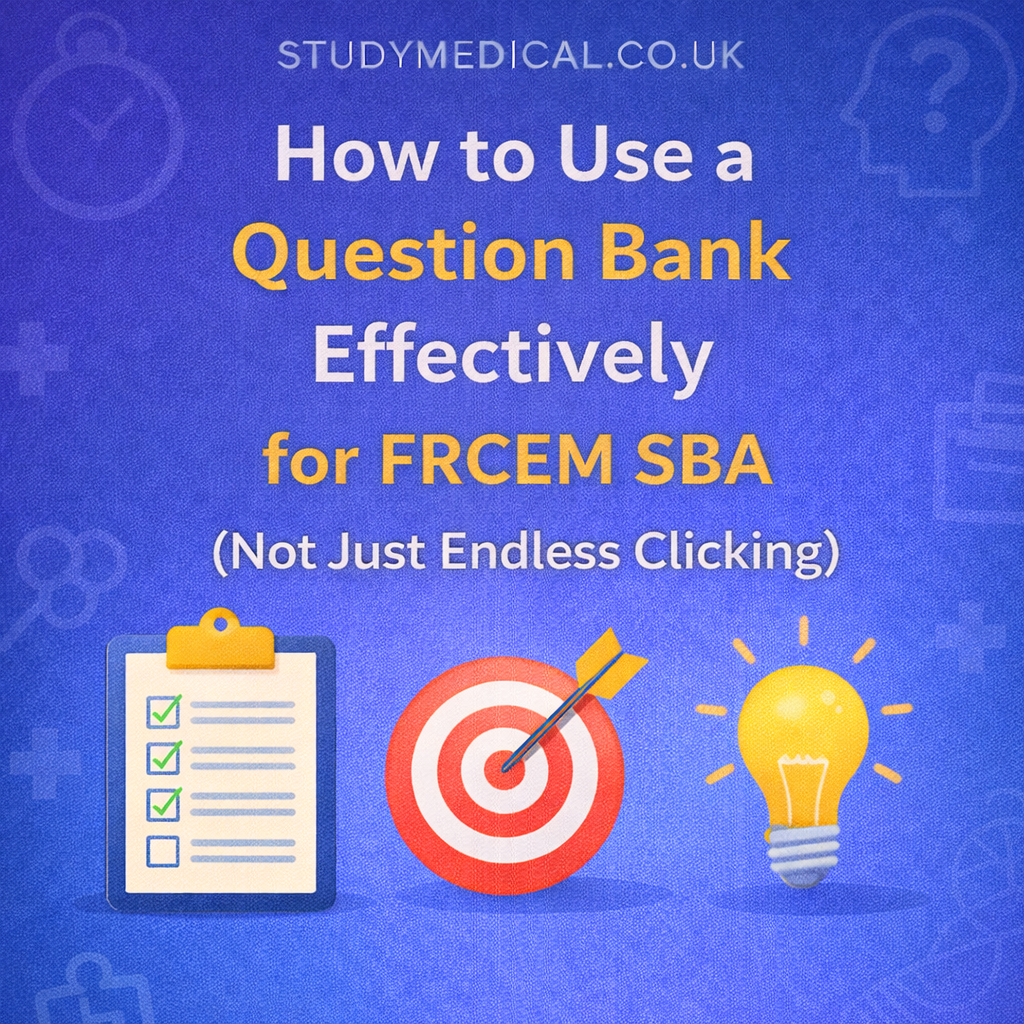
How to Use a Question Bank Effectively for FRCEM SBA: A Practical Guide for Emergency Medicine Doctors
You’ve signed up to a FRCEM SBA question bank, done a few sessions… and suddenly you’re 1,200 questions deep with no idea if you’re actually improving. We’ve all been there.
This post walks through a structured way to use a question bank so it becomes your primary learning engine, not just background guilt on your phone.
What Do We Mean by “Using a Question Bank Effectively” – and Why Does It Matter?
For FRCEM SBA, a question bank isn’t just a way to “see what the exam looks like”. Used properly, it is:
- A diagnostic tool to reveal gaps.
- A memory tool (active recall + spaced repetition) to make knowledge stick.
- A simulation tool for exam conditions, timing and stamina.
In EM, you’re juggling shifts, nights and life. You don’t have time for inefficient revision. A structured question bank strategy gives you maximum learning per minute, and that’s exactly what the FRCEM SBA will reward – rapid pattern recognition, guideline-aware management and safe decision-making.
This is why the exam is essentially built out of question-bank-style vignettes: single best answers, image interpretation, guideline cut-offs, “next best step” in realistic ED scenarios.
How Question Banks Reflect the FRCEM SBA Exam
Question banks mirror the common FRCEM SBA question angles, for example:
- Diagnosis / recognition
- Picking the most likely diagnosis from a short ED vignette.
- Initial investigation choice
- “Most appropriate next investigation” rather than “what could you do”.
- First-line management
- Correct drug, dose, route, sequence – often guideline-based.
- Complications / red flags
- “Most concerning” symptom, sign or investigation that changes what you do.
- Risk, law & ethics, management and QI
- Capacity, documentation, complaints, QI tools, duty of candour.
Common formats you’ll see in both bank and exam:
- Short clinical vignettes with full vitals and focused history.
- Image-based questions – ECGs, CXRs, CT heads, rashes, US images.
- Guideline-based “next best step” – differentiating safe from unsafe choices.
- Data interpretation – ABGs, bloods, stats/EBM tables and graphs.
Mini example scenario:
A 62-year-old man presents with central chest pain… You’ve ordered the initial troponin panel. The question asks: “What is the single most appropriate next step?”A question bank lets you practise this pattern hundreds of times until your brain automatically picks the safest, most exam-aligned option, not just a vaguely reasonable one.
Core Concepts You Must Know About Using a FRCEM Question Bank
Definitions & Key Criteria
Before you start, be clear on a few concepts:
- Active recall – forcing yourself to retrieve information (answering SBAs) rather than just reading notes.
- Spaced repetition – revisiting topics at increasing intervals instead of cramming once.
- Feedback loop – using explanations + your result data to choose what to study next.
- Deliberate practice – focusing on weak areas and pushing difficulty (e.g. timed sessions, mixed topics).
Your question bank should support all of these. If you’re just clicking through, reading the stem and casually glancing at answers, you’re not using it effectively.
Assessment & “Investigations”: Diagnosing Your Weaknesses
Think like an EM doc: before treating, diagnose the problem.
Early on, use the bank as an assessment tool:
- Do mixed-tutor or untimed sessions across the curriculum.
- Don’t worry about low scores – your goal is mapping weaknesses, not ego.
- After each block, note:
- Topics you consistently miss (e.g. sepsis, sedation, gynae, law & ethics).
- Question types you struggle with (ECGs, CT heads, stats, management vs diagnosis).
Then plan focused blocks on those weak areas.
Initial “Management”: Building a Smart Study Routine
Once you know your weak spots, treat the bank like an ED resus plan:
- Baseline phase (weeks 1–4)
- 20–30 questions per day, mostly tutor mode (explanations after each Q).
- Focus on understanding why each option is right or wrong.
- Start a mistake log or flashcards of key learning points.
- Consolidation phase (weeks 5–8)
- Mix topic-focused sessions (to fix weaknesses) with mixed sessions (to simulate exam breadth).
- Start adding timed blocks (e.g. 25 Qs in exam mode with no explanations until the end).
- Exam simulation phase (final 4 weeks)
- Do full, timed mock exams on the bank’s exam mode.
- Review your performance by topic and only then go back to guidelines/notes to plug gaps.
Red Flags and Pitfalls in Question Bank Use
There are some classic “do not miss” mistakes in how candidates use QBs:
- Endless scrolling without active recall
- Just reading stems and explanations without answering first = zero retrieval practice.
- Peeking at answers
- Looking at the options or explanation “just to check” before deciding ruins the learning.
- Ignoring explanations when you get it right by luck
- “Green tick” ≠ you understood it. If you guessed, read the explanation and log the learning point.
- Revisiting only your favourite topics
- Comfort revision feels nice but doesn’t raise your overall mark.
- Not reviewing incorrect questions
- The marks you gain usually come from fixing errors, not polishing existing strengths.
Special Populations: Shift-Workers, Non-Training Grades & Parents
Your reality: nights, weekends, childcare, rota gaps. Your question bank strategy needs to reflect that.
- Micro-sessions (5–10 questions) on breaks or commutes are still valuable – if you review explanations properly.
- Non-training grade / portfolio pathway doctors
- Use performance data (by topic, over time) as objective evidence of progression and learning for your portfolio.
- Parents / carers
- Build a realistic minimum (e.g. 10–15 questions per day) and treat extra questions as a bonus, not the expectation.
Common FRCEM SBA Traps When Using a Question Bank
Question writers and revision habits both create traps. Here are some to avoid:
- Trap 1: Memorising the question, not the concept
- If you see the same SBA twice and think “oh yeah, it was C last time”, you’re gaming the software, not the exam.
- Fix: Ask yourself: “What is this question really testing?” and write a one-line rule (e.g. “Hyponatraemia: correct slowly unless actively seizing”).
- Trap 2: Picking what is reasonable, not the single best answer
- Many options are “not wrong”, but one is most guideline-aligned and exam-safe.
- Fix: Regularly cross-reference with RCEM/NICE guidance after question sessions.
- Trap 3: Confusing similar conditions
- Example: sepsis vs anaphylaxis vs adrenal crisis; STEMI vs pericarditis vs takotsubo.
- Fix: Create mini-comparison tables in your notes: key features, key management differences.
- Trap 4: Ignoring contraindications and context
- Giving a drug or ordering a scan that’s usually correct, but wrong for this patient (renal failure, pregnancy, anticoagulation, etc.).
- Fix: When you review a Q, always ask: “What detail in the stem made the other options unsafe?”
- Trap 5: Over-reliance on one question bank
- One bank is your main engine, but if you’ve exhausted it and memorised questions, you may overestimate your ability.
- Fix: In the final weeks, consider doing a small sample from another source or official sample questions to check transferability.
High-Yield Study Patterns When Using a FRCEM Question Bank
“Classic Presentation” Study Pattern – The Ideal Day
- 20–30 mixed questions in tutor mode.
- Review all explanations, not just incorrect ones.
- Add 3–5 key points to your mini-notes/flashcards.
- Brief guideline skim (5–10 minutes) on the worst-performing topic from that session.
“Atypical Presentation” – Busy Shift Week
- 2–3 micro-sessions per day of 5–10 questions each (phone-friendly).
- Focus on previously incorrect or flagged questions.
- Weekend: one longer review block (e.g. 40–50 questions).
“Dangerous Mimics” – Study Patterns That Look Productive But Aren’t
- Spending an hour reading explanations but answering zero questions.
- Doing hundreds of SBAs on a single topic you’re already good at.
- Doing only image questions (or only text questions) when the exam mixes both.
You’ll learn to recognise these patterns in yourself. When you spot them, gently redirect back to purposeful practice.
How to Revise This Topic Efficiently for the FRCEM SBA
(Yes, meta – revising how you revise.)
Use Question Banks First, Then Guidelines
- Do a block of questions on a theme (e.g. sepsis, chest pain, CT head).
- Look at your performance and list the subtopics you missed (e.g. sepsis fluid bolus volume, oxygen targets in COPD).
- Go to guidelines or RCEM Learning and read only those specific sections.
- Re-test yourself on the same theme a few days later.
This makes guidelines feel targeted and high-yield, not like reading a PDF desert.
Build Mini-Notes or Flashcards from Mistakes
For each incorrect or lucky guess, capture three things:
- What was tested?
- e.g. “Management of AF with fast ventricular response in haemodynamically stable patient.”
- Why was I wrong?
- Misread vitals? Forgot a contraindication? Didn’t know a guideline cut-off?
- One-liner rule
- “Stable AF with RVR – rate control first-line with β-blocker or diltiazem (unless… ).”
Review these micro-notes periodically. Over time, you’ll build a personal, exam-specific handbook of your blind spots.
Mix Text-Based and Image-Based Questions
The FRCEM SBA will absolutely test:
- ECGs (arrhythmias, ischaemia, conduction blocks).
- CXRs and CT heads.
- Photographs of rashes, eyes, ENT findings.
- US stills (AAA, eFAST views), CTAs, CTPAs.
Make sure your question bank sessions include image-only and image-heavy blocks. This trains your brain to:
- Extract key findings fast.
- Link them to management decisions, not just a label.
How StudyMedical Covers This Topic in Its FRCEM SBA Question Bank
StudyMedical is built around the idea that how you use a question bank matters as much as the questions themselves. To support effective revision, the platform includes:
- Curriculum-mapped FRCEM SBA questions with full vitals, realistic ED vignettes and UK-guideline-aligned answers.
- Image-based SBAs (ECGs, X-rays, CT, US, rashes) alongside text questions, so you can build a mixed session that mirrors the real exam.
- Detailed explanations for every option, including why the wrong answers are wrong, with references to RCEM/NICE/specialty guidance where relevant.
- Smart modes so you can:
- Focus on new questions to build breadth.
- Drill into previously incorrect or flagged questions for depth.
- Run exam-mode mocks with no explanations until the end.
FAQs: Using a Question Bank for the FRCEM SBA
How often should I use a FRCEM SBA question bank?
Most candidates benefit from daily contact, even if it’s just 10–15 questions on busy days. Consistency beats occasional 200-question marathons.
How many FRCEM SBA questions should I aim to do before the exam?
There’s no magic number, but a common ballpark is 2,000–3,000 question attempts, including repeats of incorrect/flagged questions. Focus on learning from each one, not just hitting a total.
Should I read guidelines before or after using the question bank?
Use the question bank first to expose your gaps, then use guidelines to fill them. This is more efficient than trying to read everything first.
Is it better to do topic-wise or mixed sessions?
Early on, do topic-wise sessions to build foundations. Closer to the exam, switch to mixed, timed blocks to simulate the real paper.
Can I rely on just one question bank for FRCEM SBA?
You can pass with one high-quality, up-to-date bank if you use it properly. In the last weeks, a small sample from another source or official material can help check your readiness.
Key Takeaways: Using a FRCEM Question Bank in 5 Bullet Points
- Always answer first, then read explanations – no answer-peeking.
- Use performance data to drive your reading – guidelines should plug specific gaps, not be read at random.
- Log your mistakes and turn them into one-line rules or flashcards.
- Mix tutor-mode learning with timed exam-mode mocks as the exam approaches.
- Focus on understanding concepts, not memorising specific questions or letters.
Ready to Test Yourself?
Using a FRCEM SBA question bank effectively is one of the highest-yield things you can do for this exam. It turns random vignettes into:
- A map of your weak spots.
- A library of ED patterns and pitfalls.
- A safe space to make mistakes before they cost you marks (or patient harm).
👉 Create a targeted FRCEM SBA revision session in the StudyMedical question bank today – start with your weakest topic, review every explanation, and watch your scores (and confidence) climb.