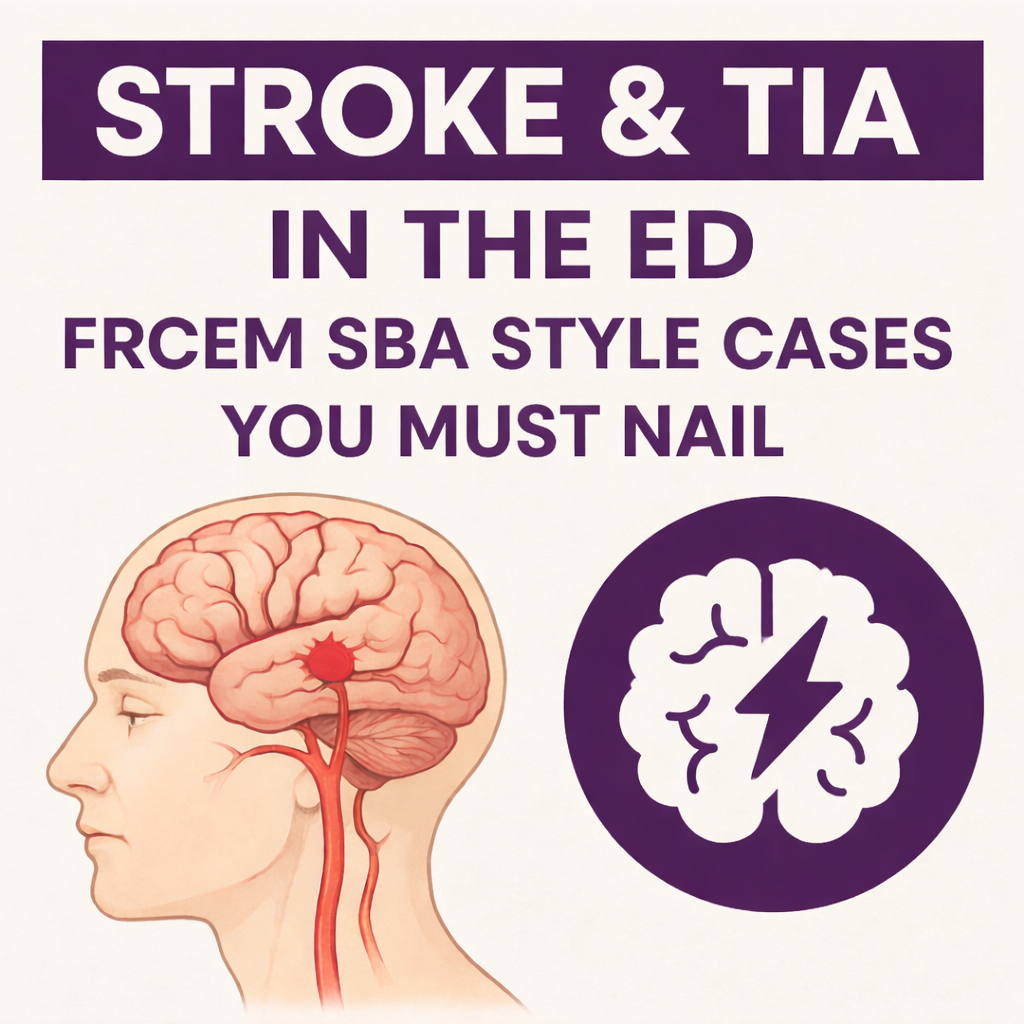
Stroke & TIA in the ED for FRCEM SBA: A Practical Guide for Emergency Medicine Doctors
What Are Stroke & TIA and Why Do They Matter in the ED?
A stroke is a sudden onset of focal neurological deficit due to a disturbance in cerebral blood flow. Clinically we usually split it into:
- Ischaemic stroke – arterial occlusion (≈85% of cases).
- Haemorrhagic stroke – intracerebral or subarachnoid bleeding.
A transient ischaemic attack (TIA) is a transient episode of neurological dysfunction caused by focal brain, spinal cord or retinal ischaemia without acute infarction – symptoms fully resolve, but stroke risk is high in the following hours–days. (RCP)
NICE NG128 covers diagnosis and initial management of stroke and TIA in over-16s for the first 48 hours after symptom onset. (NICE)
For EM, stroke/TIA are time-critical, high-stakes presentations where ED decisions directly affect disability and mortality. For the FRCEM SBA, they are classic exam fodder: pre-alert, thrombolysis, thrombectomy, blood pressure, TIA aspirin vs imaging and “who can go home vs who must stay”.
How Stroke & TIA Appear in the FRCEM SBA Exam
Expect questions around:
- Diagnosis / recognition
- FAST / BEFAST signs, sudden focal deficit, stroke mimics.
- Distinguishing stroke vs TIA (persistent vs resolved deficit, imaging evidence).
- Initial investigation choice
- Timing of urgent non-contrast CT head for suspected stroke. (NICE)
- When CT is not indicated in suspected uncomplicated TIA.
- When to add CT angiography (CTA) / MR imaging.
- First-line management
- Thrombolysis (alteplase) indications / contraindications and 4.5-hour window. (NICE)
- Thrombectomy eligibility (large vessel occlusion, time windows). (Doc Library RCHT Cornwall)
- Aspirin start in ischaemic stroke and suspected TIA. (NICE)
- Complications / red flags
- Malignant MCA syndrome, posterior circulation stroke, brainstem signs, reduced GCS.
- High-risk TIA features and early stroke risk.
Common formats:
- Classic hemiparesis + facial droop vignette with CT/door-to-needle timing.
- Posterior circulation cases with vertigo, ataxia and subtle exam signs.
- TIA pathway questions: aspirin now? CT now? Specialist review when? (NICE)
Example micro-scenario:
A 69-year-old woman presents with 45 minutes of left arm weakness and dysarthria that resolved in the waiting room. She’s now neurologically normal. Obs are stable. What is the single most appropriate next step in management?
Core Concepts You Must Know About Stroke & TIA
Definitions & Key Criteria
Key exam-level definitions:
- Stroke (clinical) – sudden onset focal neurological deficit lasting >24 hours, or leading to death, with vascular cause.
- Stroke (imaging / tissue-based) – acute infarction or haemorrhage on imaging in a patient with appropriate symptoms. (PubMed)
- TIA – transient focal neurological symptoms due to ischaemia without infarction, usually resolving within minutes to hours. (RCP)
NICE NG128 emphasises:
- Rapid recognition and pre-alert of suspected stroke.
- Hyperacute pathway with stroke team and imaging within 1 hour of arrival where possible. (NICE)
For TIA:
- NICE/RCP guidance now essentially says: every suspected TIA should be assessed urgently by a specialist within 24 hours, without relying on ABCD2 to delay low-risk cases – though ABCD2 can still help estimate stroke risk. (Clinical Knowledge Summaries)
Assessment & Investigations
History & exam
- Onset: exact time last known well (key for thrombolysis/thrombectomy).
- Symptom pattern: unilateral weakness, aphasia, facial droop, visual loss, ataxia, dizziness, diplopia, dysphagia.
- Risk factors: AF, previous stroke/TIA, hypertension, diabetes, smoking, hyperlipidaemia, carotid disease.
- Red flag features for stroke mimics (see below).
Severity scoring
- NIHSS is commonly used in stroke units; FRCEM might reference it but won’t expect fine-grained scoring – more: “severe” vs “mild”.
Imaging
From NG128 and national clinical stroke guidelines: (NICE)
- Suspected acute stroke:
- Urgent non-contrast CT head (ideally within 1 hour of arrival) to distinguish haemorrhage vs ischaemic stroke and identify mimics.
- Consider CT angiography if large vessel occlusion/ thrombectomy pathway is available or suspected.
- Suspected TIA (now neurologically back to baseline):
- Do NOT routinely perform acute CT just because of TIA; image only if suspicion of alternative diagnosis (e.g. tumour, subdural, bleed, stroke mimic) or if symptoms persist/progress. (NICE)
Bloods & ECG
- Glucose, U&Es, FBC, clotting, lipids later.
- ECG and continuous monitoring – AF, other arrhythmias.
Initial ED Management
Suspected stroke
- Treat as time-critical:
- Pre-alert stroke team if local pathway. (Clinical Knowledge Summaries)
- ABCDE – secure airway, maintain sats (usually ≥94% unless COPD), manage BP carefully (don’t reflexively drop it).
- Check capillary glucose – treat hypo immediately.
- If CT confirms ischaemic stroke and patient meets criteria:
- Consider IV alteplase within 4.5 hours of symptom onset, in line with NICE TA264 and local protocols. (NICE)
- Consider mechanical thrombectomy for large vessel occlusion within guideline time windows (often up to 6 hours, and up to 24 hours in selected patients based on advanced imaging). (Doc Library RCHT Cornwall)
- Start aspirin 300 mg once haemorrhage is excluded (usually after CT; in patients treated with thrombolysis, antiplatelets usually start after 24-hour scan). (National Clinical Guideline for Stroke)
- If CT shows intracerebral haemorrhage:
- Refer urgently to stroke/neurosurgery, manage blood pressure as per guideline, reverse anticoagulation, treat raised ICP, admit to stroke or neuro ICU. (NICE)
Suspected TIA (neurologically normal when you see them)
NICE NG128 and RCP guidance: (NICE)
- Aspirin 300 mg immediately (unless contraindicated).
- Arrange urgent specialist stroke/TIA clinic assessment within 24 hours of symptom onset (not next week).
- Admitting patients if specialist review can’t be guaranteed within 24 hours or if recurrent/ongoing symptoms or other concerns (e.g. anticoagulated, crescendo TIA).
ABCD2 is now more for estimating risk than deciding who can wait days; NICE and RCP emphasise urgent review for all suspected TIAs. (GPnotebook)
Red Flags and Pitfalls
Red flags:
- Reduced GCS, airway compromise, vomiting, aspiration risk.
- Posterior circulation symptoms: ataxia, dysarthria, diplopia, “locked-in” features.
- “Malignant” MCA syndrome: dense hemiplegia, gaze deviation, reduced conscious level.
- Recurrent TIAs (“crescendo TIAs”) – super high short-term stroke risk.
Pitfalls FRCEM loves:
- “CT normal” early ischaemic stroke – CT can be normal initially; rely on clinical picture and MRI/serial imaging when appropriate. (NICE)
- Assuming transient symptoms = benign; missing high-risk TIA.
- Over-using CT/MRI in textbook low-risk TIA where the priority is aspirin + 24-hour specialist assessment, not a normal scan at 3AM.
Special Populations
- Young stroke – dissection, PFO, thrombophilia, vasculitis; exam questions may hint at neck trauma, connective tissue disease or pregnancy.
- Anticoagulated patients – higher risk of ICH; reversal strategies (vitamin K, PCC, DOAC reversal) come into play. (NICE)
- Mimics – seizure with Todd’s paresis, functional weakness, migraine with aura, hypoglycaemia, brain tumour. Being able to tease these out is a classic SBA twist.
Common FRCEM SBA Traps Related to Stroke & TIA
“Question writers love to test the difference between X and Y…”
- Stroke vs TIA vs mimic
- Trap: Discharging a high-risk patient as “migraine” because CT is normal and symptoms improved.
- Fix: TIA/stroke are clinical diagnoses; a normal CT does not rule out TIA/early infarct.
- CT for everyone with suspected TIA
- Trap: Ordering CT head in every transient episode with a classic TIA story and normal exam.
- Fix: NG128 explicitly says do not offer CT brain in uncomplicated suspected TIA unless alternative diagnoses are suspected. (NICE)
- Waiting for imaging before aspirin in TIA
- Trap: Withholding aspirin “until CT tomorrow” in a classic TIA.
- Fix: NICE: aspirin 300 mg for suspected TIA should be started immediately, unless contraindicated. (NICE)
- Misunderstanding the thrombolysis window
- Trap: Thinking thrombolysis is an option at 8 hours from onset just because the patient arrived late.
- Fix: IV alteplase is generally recommended within 4.5 hours of onset in suitable ischaemic stroke patients, per NICE and most national guidelines. (NICE)
- Using ABCD2 as a gatekeeper to care
- Trap: Delaying low-ABCD2 TIA patients for days.
- Fix: NICE/RCP now recommend all TIAs be seen within 24 hours; ABCD2 may inform risk but not whether they deserve urgent review. (Clinical Knowledge Summaries)
High-Yield Clinical Patterns for Stroke & TIA in the ED
Classic Presentation – Hyperacute Stroke
Age: 74-year-old manHistory: Suddenly collapsed at home 45 minutes ago with right-sided weakness and slurred speech.Obs: BP 180/95, HR 88, RR 18, SpO₂ 96% RA, GCS 15Exam: Right facial droop, right arm and leg weakness, expressive dysphasia.
Key points:
- Clear FAST-positive stroke within thrombolysis window.
- ED role: pre-alert stroke team, rapid CT, thrombolysis/thrombectomy decision, BP management.
Classic Presentation – TIA (“Resolved Stroke”)
Age: 68-year-old womanHistory: 30 minutes of left arm weakness and expressive dysphasia 3 hours ago, now completely resolved. AF on apixaban. Exam: Now normal neuro exam; obs stable.
Key points:
- Classic TIA in a high-risk patient (AF, anticoagulated).
- Needs aspirin if no contraindication, urgent specialist assessment within 24 hours, and consideration of admission if urgent clinic not available or red flags (anticoagulated, recurrent events). (NICE)
Atypical Presentation – Posterior Circulation Stroke
Age: 55-year-oldHistory: Sudden onset vertigo, vomiting, inability to stand, double vision, slurred speech.Exam: Horizontal nystagmus, limb ataxia, dysarthria, intact power but cannot walk unaided.
Key points:
- Easily mislabelled as “labyrinthitis”.
- Posterior circulation stroke has higher miss rate; FRCEM loves this pitfall. Early CT may be normal; MRI and neurology input essential.
Dangerous Mimics
Important differentials:
- Hypoglycaemia – always check glucose.
- Seizure with Todd’s paresis – transient weakness post-ictal.
- Migraine with aura – spreading sensory/visual changes, often with headache.
- Functional neurological disorder – often inconsistent findings, but exam is tricky and FRCEM won’t expect heroics; they’ll test that you don’t miss stroke.
How to Revise Stroke & TIA Efficiently for the FRCEM SBA
Use Question Banks First, Then Guidelines
- Do focused blocks of stroke/TIA SBAs:
- Hyperacute stroke, haemorrhagic vs ischaemic, thrombolysis timing, TIA clinic referrals.
- Then read the high-yield sections of:
- NICE NG128 – Stroke and TIA in over 16s: diagnosis and initial management. (NICE)
- National Clinical Guideline for Stroke (RCP / Intercollegiate Stroke Working Party) – especially acute care chapter. (stroke.org.uk)
- RCP concise TIA guideline for ED-facing TIA management. (RCP)
- RCEMLearning “Stroke in the ED” and “TIA” reference pages for UK EM flavour. (rcemlearning.co.uk)
Build Mini-Notes or Flashcards from Mistakes
Each time you miss a stroke/TIA SBA:
- Write what the stem hinged on:
- CT vs no CT in TIA.
- Aspirin timing.
- Thrombolysis inclusion/exclusion criteria.
- Specialist assessment within 24 hours.
- Then a one-liner:
These become gold in the last revision week.
Mix Text-Based and Image-Based Questions
- Combine vignettes with CT head images:
- Large MCA infarct, early ischaemic changes, ICH vs infarct.
- Add ECG snippets showing AF or MI as source.
- Use flow-chart style SBAs around thrombolysis/thrombectomy and TIA pathways.
This mirrors real-life ED decision-making and tests the guideline bits that examiners love.
How StudyMedical Covers Stroke & TIA in Its FRCEM SBA Question Bank
StudyMedical includes a broad set of curriculum-mapped stroke and TIA questions aligned to the RCEM 2021 curriculum and current NICE/UK stroke guidance.
For this topic, you can highlight:
- Full-vignette stroke SBAs
- Pre-alert, imaging decisions, thrombolysis inclusion/exclusion, mechanical thrombectomy referrals, malignant MCA syndrome, haemorrhagic stroke management.
- TIA-focused SBAs
- Classic vs atypical TIAs, aspirin timing, “who needs admission vs next-day clinic”, anticoagulation and carotid disease.
- Image- and data-based SBAs
- CT head slices (normal vs infarct vs bleed), simple CTA descriptions, NIHSS snippets, ABCD2 examples.
- Guideline-anchored explanations
- Explicit references to NICE NG128, RCP TIA guidance and National Clinical Guideline for Stroke, so revising with the bank doubles as guideline revision. (NICE)
- Smart revision modes
- New mode to build your base.
- Incorrect mode to drill gnarly thrombolysis/TIA timing questions.
- Flagged mode to create your own “must-nail” stroke/TIA mini-deck.
FAQs About Stroke & TIA in the FRCEM SBA
How often do stroke and TIA questions appear in the FRCEM SBA exam?
Very frequently. Stroke/TIA sit at the intersection of resus, neurology, imaging, and guidelines – exactly the kind of multi-domain topics examiners love.
What’s the single most important thing to remember about stroke/TIA for the exam?
Time is brain: rapid recognition + correct imaging + guideline-driven therapy (thrombolysis/thrombectomy or aspirin + urgent specialist review) is everything.
Are there must-know guidelines or scores?
Yes:
- NICE NG128 – Stroke and TIA in over 16s (diagnosis and initial management). (NICE)
- National Clinical Guideline for Stroke (RCP). (bgs.org.uk)
- RCP TIA concise guideline and ABCD2 score (mainly for risk estimation). (RCP)
How many stroke/TIA-related questions should I aim to do before the exam?
Aim for at least 40–60 dedicated stroke/TIA SBAs, plus plenty of mixed neuro/resus questions, until thrombolysis windows, TIA pathways, and CT vs MRI decisions feel automatic.
Key Takeaways: Stroke & TIA for FRCEM in 5 Bullet Points
- Stroke vs TIA is a clinical + imaging distinction – transient symptoms can still carry very high stroke risk. (NICE)
- Acute stroke needs rapid CT (± CTA), thrombolysis within ~4.5 hours and consideration of thrombectomy in suitable patients. (NICE)
- Suspected TIA → aspirin 300 mg now + specialist neurovascular assessment ≤24 hours, not “routine clinic next week”. (NICE)
- Not every TIA needs CT in the ED, but everyone needs a clear plan and safety-netting; use imaging selectively for mimics/alternative diagnoses. (NICE)
- The fastest way to nail this for FRCEM is lots of stroke/TIA SBAs plus a quick pass through NG128 and the National Stroke Guideline.
Ready to Test Yourself on Stroke & TIA?
Stroke and TIA are quintessential EM problems – high volume, high impact and heavily represented in the FRCEM SBA:
- Mastering them improves both exam performance and real-life patient outcomes.
- The winning combo is pattern-recognition through SBAs + sharp recall of NICE/RCP pathways.