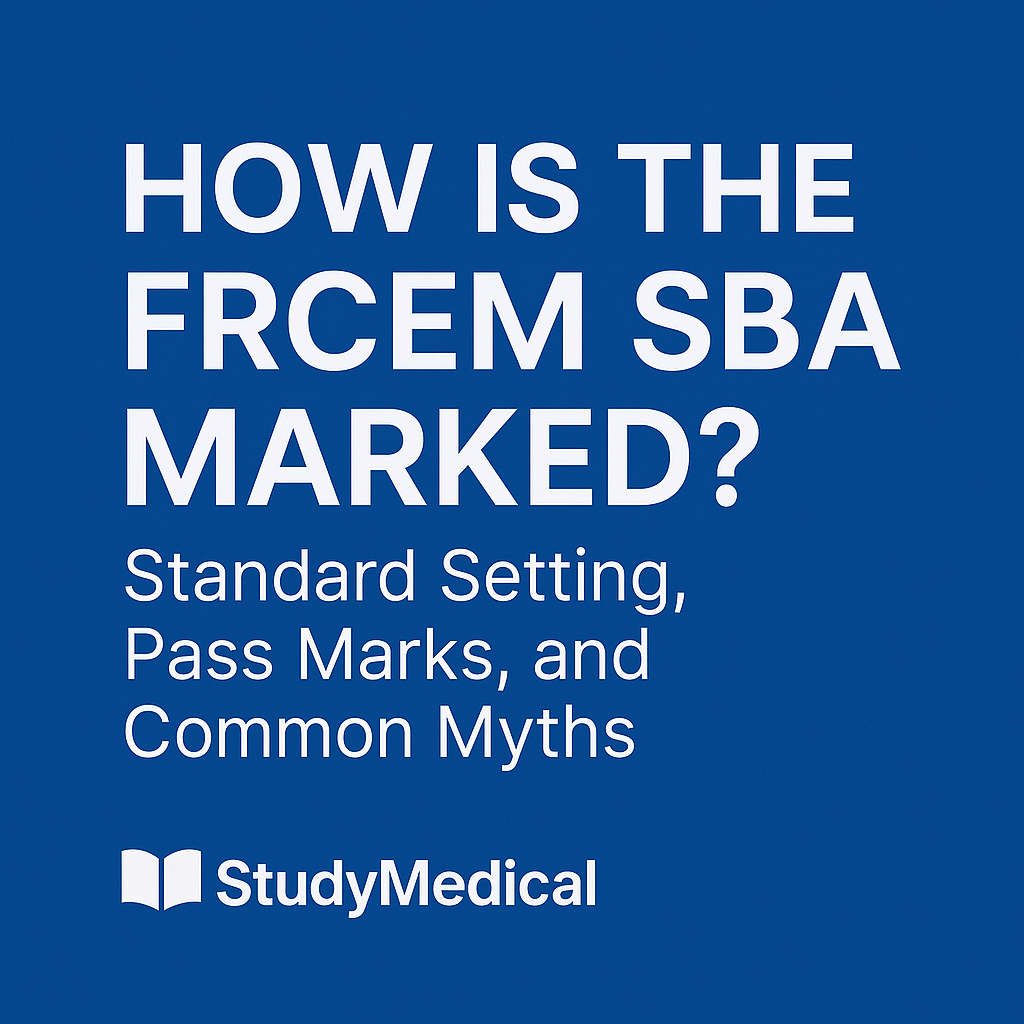
If you’re preparing for Fellowship, you’ve probably heard all kinds of stories about how the FRCEM SBA is marked:
- “You need 70% to pass.”
- “They decide the pass mark after seeing how everyone did.”
- “Some questions don’t count, but they won’t tell you which.”
The reality is much more structured and transparent than the rumours suggest. RCEM uses a formal Angoff standard-setting process plus statistical checks and a defined approach to pass marks across all SBA papers. (RCEMCurriculum)
Understanding this doesn’t magically give you extra marks—but it does help you set realistic goals, interpret your feedback letter properly, and avoid a lot of unhelpful anxiety.
What Is FRCEM SBA Marking and Why Does It Matter?
In simple terms, FRCEM SBA marking is the system RCEM uses to turn your answers on the day into a fair, defensible pass/fail decision:
- Every SBA is machine-marked.
- You get 1 mark for each correct answer, 0 for an incorrect answer, and no negative marking. (RCEM)
- The standard (pass mark) is set using the Angoff method, with +1 Standard Error of Measurement (SEM) added to the cut score to create the final pass mark. (RCEMCurriculum)
For emergency physicians, this matters because:
- This is a high-stakes hurdle that affects your progression, CESR/portfolio pathway planning, and ultimately your ability to practise as a consultant.
- It’s part of a wider criterion-referenced assessment programme—you’re being judged against a defined standard of practice, not against your peers. (RCEMCurriculum)
From an FRCEM SBA exam perspective, this topic appears indirectly in questions about assessment, education, quality, stats and governance (SLOs 7, 10, 11, 12), and crops up in viva prep and consultant-level interview discussions.
How the Angoff Process Works (Step by Step)
RCEM describes a question-centred Angoff approach: (RCEMCurriculum)
- A panel of trained examiner “Angoff judges” review each SBA.
- For each question, each examiner estimates:
“What proportion of minimally competent candidates would get this question right?”
(e.g. 0.9 for an easy item, 0.5 for a borderline item, 0.2 for a very hard item.)
- These probabilities are averaged across examiners for each question.
- The averages are summed across all questions to produce a cut score (e.g. 103/180).
- RCEM then adds +1 Standard Error of Measurement (SEM) to this cut score to set the final pass mark. (RCEMCurriculum)
This pass mark is set before results are released and is not adjusted simply to hit a target pass rate.
Why the Pass Mark Changes Every Sitting
Because the Angoff panel judges each new paper:
- If a paper is harder, the expected proportion of minimally competent candidates answering correctly is lower, so the cut score is lower.
- If a paper is easier, the cut score is higher.
External data show that, for example, the October 2024 FRCEM SBA pass mark was 108/180 (~60%), but this varies between diets. (bromleyemergency.com)
Therefore:
- There is no fixed “70% rule”.
- You cannot know the exact pass mark in advance, but you can infer that it often sits somewhere around the upper 50s–60s% region, depending on difficulty.
Post-Exam Item Analysis and “Removed Questions”
After each exam, RCEM does item analysis:
- Questions with unexpectedly poor performance (e.g. almost no-one gets them right, options mis-keyed, ambiguous wording) are flagged. (RCEMCurriculum)
- If a question is judged problematic, it can be removed from the paper before scores are finalised—meaning it no longer contributes to the total mark. (RCEMCurriculum)
Crucially:
- You are not punished if you got a flawed question wrong.
- The maximum possible score can drop a little if items are removed, and your percentage is calculated against the new maximum.
How FRCEM SBA Fits into the Whole Programme of Assessment
The FRCEM SBA is one component of a larger, conjunctive assessment scheme:
- Written SBAs (MRCEM Primary, MRCEM Intermediate, FRCEM SBA) – Angoff-set, question-centred exams.
- OSCEs (MRCEM & FRCEM) – borderline regression, candidate-centred standard setting, plus some conjunctive rules (e.g. must pass at least one resus station). (RCEMCurriculum)
- WPBAs, FEG statements and ARCP decisions.
You have to meet the standard in each element—a strong performance in the SBA cannot compensate for failing the OSCE, and vice versa. (RCEMCurriculum)
Common FRCEM SBA Traps Related to Marking & Pass Marks
Question writers love the boundary between correct and incorrect assumptions about exams. Common traps include:
- Myth: “You need 70% to pass.”
- Reality: The pass mark is Angoff-set +1 SEM, so it varies each sitting (e.g. 108/180 in Oct 2024). (RCEMCurriculum)
- Avoidance strategy: Aim for ≥65–70% on practice papers, but understand this is a safety buffer, not a fixed rule.
- Myth: “They pick a pass rate and work backwards.”
- Reality: RCEM explicitly states exams are criterion-referenced, not norm-referenced. (RCEMCurriculum)
- Avoidance strategy: When interpreting results, focus on your raw score vs pass mark, not the percentage of colleagues who passed.
- Myth: “Some questions are ‘trial’ so I can guess more freely.”
- Reality: While flawed items can be removed after analysis, you must assume every item counts when you sit the exam. (RCEMCurriculum)
- Myth: “They’ll re-mark my paper if I’m close.”
- Reality: RCEM exams are electronically/machine-marked, and marks are not normally altered or re-marked; appeals are for procedural irregularities or exceptional circumstances, not for “I think I did better than this.” (RCEM)
- Trap: Confusing OSCE marking with SBA marking.
- SBAs: 1 mark per correct answer, Angoff + SEM.
- OSCE: domain-based scoring, borderline regression, plus specific station rules. (RCEM)
How to Revise FRCEM SBA Marking & Pass Marks Efficiently
Use Question Banks First, Then the Official Documents
- Do timed blocks of SBAs mapped to the FRCEM blueprint (180-question mock where possible). (RCEM)
- After each block, calculate:
- Raw score
- Percentage
- How that would compare to a typical pass mark (e.g. “If the pass mark were ~60%, where would I be?”). (bromleyemergency.com)
- Then read the RCEM Programme of Assessment and FRCEM Exams FAQs to understand how your practice performance would translate into a real sitting. (RCEMCurriculum)
FAQs About FRCEM SBA Marking & Pass Marks
Q1: Is the FRCEM SBA pass mark always 70%?
No. The pass mark is set using the Angoff method +1 SEM, so it varies each sitting depending on paper difficulty—for example, it was 108/180 (~60%) for one recent diet. (RCEMCurriculum)
Q2: Does RCEM decide the pass mark after seeing how people did?
The Angoff cut score is set a priori by examiners judging how a minimally competent candidate would perform on each question, then adjusted by adding one SEM. This is a criterion-referenced process, not a post-hoc norm-referenced one. (RCEMCurriculum)
Q3: Are all questions counted towards my final score?
All questions are intended to count. However, after item analysis, RCEM may remove problematic items (e.g. ambiguous or mis-keyed questions) before finalising scores. This can change the maximum possible mark but protects candidates from unfair items. (RCEMCurriculum)
Q4: Will RCEM re-mark my paper if I’m close to the pass mark?
RCEM theory exams are electronically/machine-marked, and marks are not routinely adjusted or re-marked. You can appeal only on the basis of procedural irregularity or exceptional circumstances, as set out in the Appeals Policy. (RCEM)
Q5: How many marks should I aim for in practice?
Because pass marks vary, it’s sensible to aim for ≥65–70% on high-fidelity practice mocks. This gives you headroom above likely Angoff-derived pass marks while accounting for exam-day stress.
Key Takeaways: FRCEM SBA Marking in 5 Bullet Points
- Every question matters: 1 mark for each correct SBA, no negative marking, machine-marked. (RCEM)
- Standard setting is Angoff-based: pass mark = examiner-judged cut score for a minimally competent candidate +1 SEM. (RCEMCurriculum)
- Pass mark varies between diets: it is not a fixed 70%; recent examples sit around the 60% region depending on difficulty. (bromleyemergency.com)
- RCEM exams are criterion-referenced, not norm-referenced: you’re judged against a standard, not against your peers. (RCEMCurriculum)
- Feedback letters are powerful tools: they show your raw score, the pass mark, cohort average and SLO-level performance—use this to drive targeted, SLO-aligned revision. (RCEM)