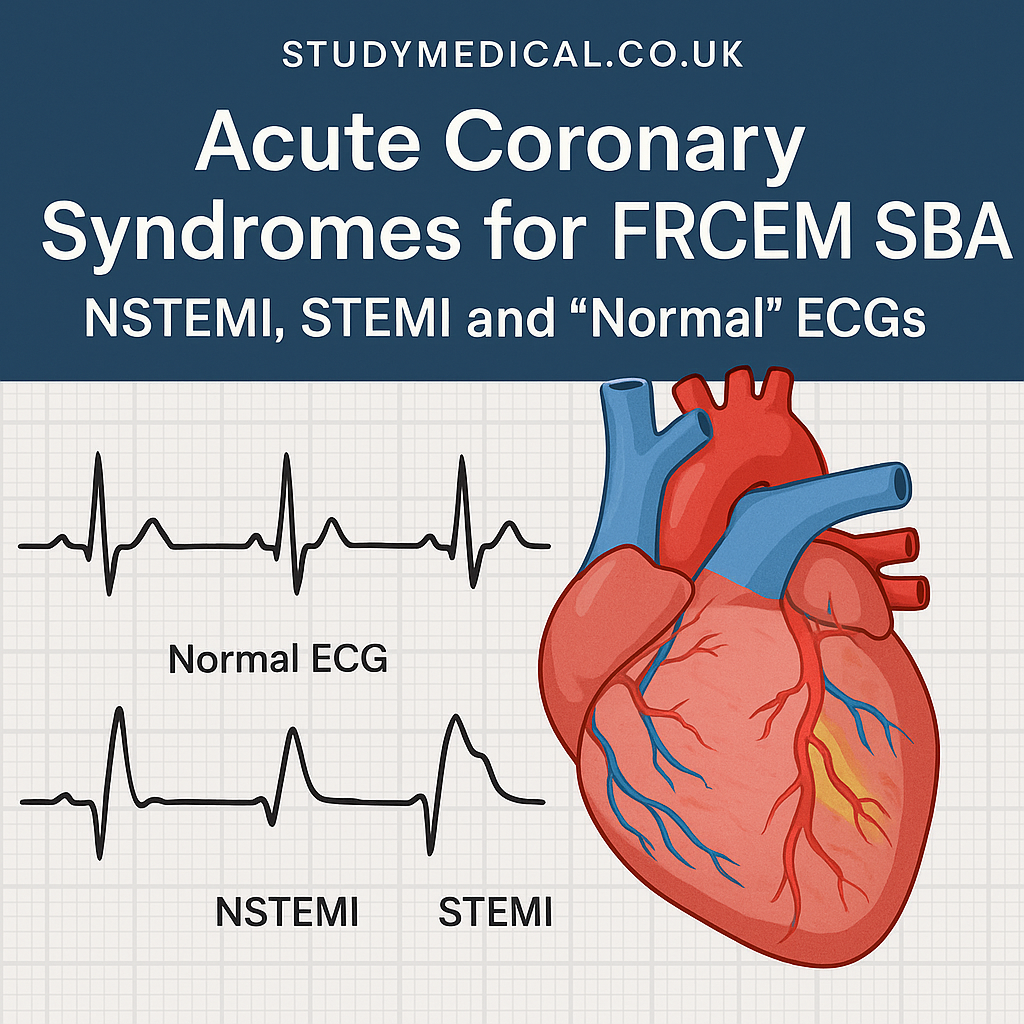
Acute Coronary Syndromes for FRCEM SBA: NSTEMI, STEMI and “Normal” ECGs – A Practical Guide for Emergency Medicine Doctors
What Are Acute Coronary Syndromes and Why Do They Matter in the ED?
Acute coronary syndrome (ACS) is an umbrella term for clinical presentations of myocardial ischaemia due to acute coronary artery obstruction. It includes:
- ST-elevation myocardial infarction (STEMI)
- Non-ST elevation myocardial infarction (NSTEMI)
- Unstable angina (UA) (NICE)
The current NICE ACS guideline (NG185) covers early and long-term management of STEMI, NSTEMI and unstable angina, focusing on improving survival and quality of life. (NICE)
NICE CG95 (recent-onset chest pain) sets out how to assess and diagnose suspected cardiac chest pain in the ED using ECG and high-sensitivity troponin. (NICE)
ACS is core ED bread-and-butter: high incidence, high mortality and huge QIP potential. Some patients roll in with textbook ST elevation. Others have ACS with subtle changes or even “normal” ECGs, where your only clues are the history, risk factors and troponin dynamics.
For the FRCEM SBA, ACS crops up again and again as:
- Classic STEMI / NSTEMI vignettes
- Troponin / ECG interpretation questions
- Guideline-driven “next best step” scenarios
How Acute Coronary Syndromes Appear in the FRCEM SBA Exam
Typical question angles:
- Diagnosis / recognition
- Features of cardiac chest pain vs non-cardiac chest pain. (NICE)
- Differentiating STEMI, NSTEMI and unstable angina.
- Recognising high-risk features when the ECG is non-diagnostic or “normal”.
- Initial investigation choice
- When to repeat ECGs, do posterior/right-sided leads.
- High-sensitivity troponin timing (0/1-hour, 0/2-hour, 0/3-hour strategies). (European Society of Cardiology)
- Use of CXR, bedside echo and CT (PE/aortic dissection).
- First-line management
- Aspirin, second antiplatelet, anticoagulation.
- STEMI reperfusion strategy: primary PCI vs thrombolysis. (NICE)
- NSTEMI risk stratification, timing of angiography.
- Complications / red flags
- Cardiogenic shock, arrhythmias, mechanical complications (VSD, papillary muscle rupture, LV aneurysm).
- Post-MI heart failure, pericarditis.
Common formats:
- ECG image SBAs (STEMI patterns, reciprocal changes, “non-specific ST/T changes”).
- Serial troponin tables with borderline values and delta changes.
- Guideline-based “what next?” – e.g. NG185/ESC-style reperfusion criteria and NSTE-ACS invasive strategy timing. (NICE)
Example mini-scenario:
A 62-year-old man with diabetes presents with 2 hours of central chest pressure and diaphoresis. Initial ECG is non-diagnostic. First high-sensitivity troponin is mildly elevated, repeat at 1 hour shows a clear rise. What is the most appropriate next step in management?
Core Concepts You Must Know About Acute Coronary Syndromes
Definitions & Key Criteria
ACS subtypes:
- STEMI
- Transmural infarction due to acute coronary occlusion.
- Characterised by persistent ST-segment elevation in contiguous leads consistent with coronary territory, or new LBBB with ischaemic symptoms. (European Society of Cardiology)
- Requires urgent reperfusion.
- NSTEMI
- Myocardial infarction without persistent ST elevation, but with elevated troponin (rise/fall) and evidence of ischaemia (symptoms, ECG changes, imaging). (NCBI)
- Unstable angina
- Ischaemic chest pain at rest or with minimal exertion, or new onset rapidly worsening angina, without troponin rise and no clear infarction.
Universal MI definition (4th/5th UDMI) = rise and/or fall of troponin above 99th percentile + at least one of: ischaemic symptoms, new ECG changes, imaging evidence of new loss of viable myocardium or angiographic thrombus. (NCBI)
Key exam theme: patients with ACS can have a non-diagnostic or “normal” initial ECG, especially early, with posterior/isolated circumflex lesions, or in diabetics and elderly.
Assessment & Investigations
History & examination
- Symptoms:
- Classically: central chest pressure/tightness ± radiation, lasting >15 minutes, with nausea, sweating, dyspnoea. (NICE)
- Atypical: epigastric discomfort, jaw/arm pain, unexplained dyspnoea, syncope – especially in elderly, women, diabetics.
- Risk factors:
- Age, smoking, diabetes, hypertension, hyperlipidaemia, FHx IHD, CKD.
- Red flags:
- Haemodynamic instability, heart failure signs, new murmur, arrhythmias.
ECG
- Obtain a 12-lead within 10 minutes of arrival in suspected ACS and repeat if ongoing pain or changing symptoms. (NICE)
- Look for:
- ST elevation / depression, T-wave inversion, new LBBB, hyperacute T waves.
- Reciprocal changes (e.g. inferior ST elevation with lateral ST depression).
- Remember extra leads:
- V7–V9 for posterior MI (tall R in V1–V3 ± ST depression).
- V3R–V4R for right ventricular infarction in inferior STEMI.
Troponin & rule-out/rule-in
- Use high-sensitivity troponin; algorithms such as ESC 0/1-hour, 0/2-hour, or 0/3-hour strategies are widely adopted in UK EDs. (European Society of Cardiology)
- Interpret absolute change (delta) as well as absolute value:
- Small chronic elevation (CKD, HF) vs acute rise/fall (ACS).
Risk scores
- GRACE score for NSTE-ACS – helps stratify need/timing for invasive management. (European Society of Cardiology)
- TIMI or HEART may also be referenced in FOAMed/ESC resources for ED risk stratification.
Initial ED Management
Think ABCDE + anti-ischaemic bundle:
- A/B/C: resus first
- Oxygen only if SpO₂ <94% (or individual targets – e.g. in COPD). (BNF)
- Treat shock/arrhythmias promptly; defibrillate VT/VF.
- Antiplatelets
- Aspirin 300 mg loading for all suspected ACS without contraindications. (BNF)
- Add P2Y₁₂ inhibitor (e.g. ticagrelor) when ACS is confirmed and local pathway says so.
- Analgesia & nitrates
- IV opioids titrated to pain (with antiemetic).
- Sublingual/IV nitrates if no hypotension/RV infarct.
- Anticoagulation
- Fondaparinux / LMWH / UFH depending on STEMI vs NSTE-ACS and PCI vs conservative approach, following local and NICE/ESC guidance. (NICE)
STEMI – reperfusion
- NICE NG185 and ESC guidelines emphasise immediate reperfusion: (NICE)
- Primary PCI within 120 minutes of first medical contact (or local “call-to-balloon” targets).
- If PCI cannot be delivered within guideline time and no contraindications, give fibrinolysis and arrange rescue PCI if needed.
NSTEMI / Unstable angina – invasive strategy
- For NSTE-ACS, ESC and NICE support early invasive management in high-risk patients: (European Society of Cardiology)
- High-risk features: positive troponin, GRACE >140, dynamic ST/T changes, haemodynamic instability, malignant arrhythmias.
- Coronary angiography usually within 24 hours for high-risk and within 72 hours for intermediate risk (local pathways vary).
“Normal” ECG / low-risk chest pain
- Use troponin algorithms + risk scores to safely rule out MI.
- If low-risk, negative serial troponins and no concerning features → discharge with appropriate follow-up per CG95. (NICE)
Red Flags and Pitfalls
Red flags:
- Ongoing or recurrent chest pain despite treatment.
- Haemodynamic compromise: hypotension, cool peripheries, confusion.
- New systolic murmur (VSD, papillary muscle rupture), pulmonary oedema.
- Dynamic ST-segment changes, broadening QRS, arrhythmias.
Pitfalls:
- Single normal ECG → falsely reassured; missing evolving STEMI/NSTEMI.
- Single early troponin → ruling out ACS when sample taken too soon.
- Anchoring on “reflux” or MSK pain in high-risk patients.
- Ignoring subtle ECG changes (isolated T-wave inversion or ST depression).
Special Populations
- Women
- More likely to present with atypical symptoms (breathlessness, fatigue, epigastric discomfort). Under-diagnosis is a known problem; FRCEM loves this. (NICE)
- Older adults & diabetics
- Silent MI or minimal pain; may present with syncope, confusion, collapse or acute HF.
- CKD
- Baseline raised troponin – rely on delta and overall picture, not a single value.
- Post-PCI / CABG
- May have atypical ECG; consider graft failure, stent thrombosis.
Common FRCEM SBA Traps Related to Acute Coronary Syndromes
Question writers love subtle distinctions:
- STEMI vs NSTEMI vs unstable angina
- Trap: Calling someone with ischaemic chest pain and a small troponin rise “unstable angina”.
- Fix: Any rise/fall of troponin above 99th percentile with ischaemic features = MI (NSTEMI if no ST elevation). (NCBI)
- Troponin timing
- Trap: Ruling out MI with a single troponin drawn 30–60 minutes after pain onset.
- Fix: Use hs-troponin algorithms (0/1-h, 0/2-h, 0/3-h), not “one and done”, unless the test and timing meet validated rule-out criteria. (European Society of Cardiology)
- Normal ECG ≠ no ACS
- Trap: Discharging high-risk chest pain because the ECG is “normal”.
- Fix: CG95 explicitly notes that ACS can occur with non-diagnostic ECG; risk-stratify and use troponin pathways. (NICE)
- Over-treating low-risk patients
- Trap: Loading a clearly low-risk, troponin-negative patient with full dual antiplatelets and anticoagulation.
- Fix: Match treatment intensity to diagnosis and risk (ACS confirmed vs ruled out).
- Misusing oxygen and opioids
- Trap: Blanket high-flow oxygen and repeated opiates in non-hypoxic ACS, increasing harm.
- Fix: Give oxygen only if hypoxic and titrate; use opioids judiciously. (BNF)
High-Yield Clinical Patterns for Acute Coronary Syndromes in the ED
Classic Presentation – Inferior STEMI
Age: 58-year-old manSymptoms: 1 hour of central chest tightness radiating to left arm, nausea, sweatyObs: HR 90, BP 105/70, RR 18, SpO₂ 95% RAECG: ST elevation in II, III, aVF with reciprocal ST depression in I, aVL
Key points:
- Classic inferior STEMI pattern.
- Think right-ventricular involvement (check right-sided leads if hypotensive with nitrates).
- FRCEM will test primary PCI vs fibrinolysis decision.
Classic Presentation – NSTEMI with Dynamic ST Depression
Age: 72-year-old woman, hypertensive, ex-smokerSymptoms: 6 hours of chest tightness and breathlessness on exertionObs: HR 96, BP 150/90, RR 20, SpO₂ 96% RAECG: ST depression and T-wave inversion in V4–V6Troponin: Raised with clear rise at 3 hours
Key points:
- High-risk NSTEMI with dynamic ST changes and positive troponin.
- Expect questions on early invasive strategy (within ~24 h), antiplatelets and anticoagulation. (European Society of Cardiology)
Atypical Presentation – “Normal” ECG ACS
Age: 64-year-old diabetic womanSymptoms: 4 hours of epigastric discomfort, nausea, “indigestion”, no obvious chest painObs: HR 88, BP 140/80, RR 18, SpO₂ 97% RAECG: Non-specific T-wave flattening onlyTroponin: Slightly elevated at presentation, significant rise at 2 hours
Key points:
- Atypical ACS with non-diagnostic ECG and subtle symptoms.
- High-yield for “don’t miss ACS just because ECG looks ‘normal’”.
Dangerous Mimics
Important alternatives you must distinguish from ACS:
- Pulmonary embolism
- Pleuritic pain, tachycardia, hypoxia, possible S₁Q₃T₃ pattern, V/Q or CTPA positive.
- Aortic dissection
- Tearing pain radiating to back, unequal BP, mediastinal widening on CXR; CT aorta.
- Pericarditis / myopericarditis
- Sharp pain worse lying flat, diffuse ST elevation + PR depression; troponin can be up but pattern/echo differ.
- GORD / MSK chest pain
- Clear positional or palpation tenderness, but beware anchoring bias in high-risk patients.
How to Revise Acute Coronary Syndromes Efficiently for the FRCEM SBA
Use Question Banks First, Then Guidelines
- Start with ACS-focused SBA blocks:
- Mix STEMI, NSTEMI, UA, and “chest pain but not ACS” cases.
- Then skim the key guideline sections:
- NICE NG185 – Acute Coronary Syndromes (STEMI + NSTE-ACS management). (NICE)
- NICE CG95 – Chest Pain of Recent Onset (assessment, ECG, troponin, referral). (NICE)
- ESC 2023 ACS guideline for troponin algorithms, risk stratification and invasive strategies. (European Society of Cardiology)
- RCEMLearning ACS/STEMI resources for UK EM nuance. (rcemlearning.co.uk)
This keeps your mental model tightly aligned with current practice rather than outdated ACS lore.
Build Mini-Notes or Flashcards from Mistakes
Every time you miss an ACS question, write:
- What the question actually tested:
- “Difference between NSTEMI and unstable angina.”
- “When to repeat troponin and which delta is significant.”
- “PCI vs thrombolysis pathway.”
- Why your answer was wrong:
- “I forgot that any troponin rise + symptoms = MI.”
- “I misapplied the rule-out algorithm timing.”
- One-liner rule:
- “Normal ECG and early troponin do not exclude ACS – follow a validated hs-troponin pathway.”
- “High-risk NSTE-ACS (GRACE >140, dynamic ST/T changes, positive troponin) → early invasive strategy.” (European Society of Cardiology)
Mix Text-Based and Image-Based Questions
- Practise ECG-based SBAs:
- Inferior / anterior / lateral STEMI, posterior MI, Wellens’, de Winter’s, etc.
- Use data-rich questions:
- Serial troponin tables and GRACE score components.
- Add imaging:
- CXR with pulmonary oedema post-MI, echo images with regional wall motion abnormalities (where available).
This mimics how ACS appears in both FRCEM SBA and your OSCE.
How StudyMedical Covers Acute Coronary Syndromes in Its FRCEM SBA Question Bank
StudyMedical includes a deep spread of curriculum-mapped ACS questions aligned with the RCEM 2021 curriculum and current UK guidelines.
- STEMI / NSTEMI / UA SBAs with full vitals and ECGs
- Realistic ED vignettes: “door-to-balloon”, transfer to PCI centre, atypical chest pain, post-MI complications.
- Image-based SBAs
- 12-lead ECGs showing classic and subtle ACS patterns, CXR for complications, data tables with serial troponin values.
- Guideline-anchored explanations
- Referencing NICE NG185, CG95, and ESC ACS guidance, plus RCEM-focused learning resources. (NICE)
- Smart revision modes
- New questions when you’re building your ACS base.
- Incorrect mode to hammer common pitfalls (e.g. troponin timing, “normal ECG” ACS).
- Flagged mode to build your own mini-ACS pack to hit in the final weeks.
H2: FAQs About Acute Coronary Syndromes in the FRCEM SBA
How often do ACS questions appear in the FRCEM SBA exam?
Very often. Chest pain and ACS are high-yield across resus, cardiology, diagnostics and guideline-based “next best step” questions, so you should expect multiple ACS-related SBAs per paper.
What’s the single most important thing to remember about ACS for the exam?
A normal initial ECG and early troponin do not reliably exclude ACS. You must combine history, risk factors, serial ECGs and a validated hs-troponin strategy to rule out MI safely.
Are there must-know guidelines or scores related to ACS?
Yes – for FRCEM you should be comfortable with:
- NICE NG185 – Acute Coronary Syndromes (STEMI and NSTE-ACS management). (NICE)
- NICE CG95 – Chest Pain of Recent Onset (assessment, ECG, troponin, risk-based referral). (NICE)
- ESC 2023 ACS guideline – especially hs-troponin algorithms and invasive strategy timing. (European Society of Cardiology)
- GRACE risk score for NSTE-ACS. (European Society of Cardiology)
How many ACS-related questions should I aim to do before the exam?
As many as you can reasonably fit. A sensible minimum is 50–100 focused ACS SBAs, plus a large number of mixed chest pain questions, until ECG patterns, troponin deltas and reperfusion decisions feel automatic.
Key Takeaways: Acute Coronary Syndromes for FRCEM in 5 Bullet Points
- ACS = STEMI, NSTEMI and unstable angina; any troponin rise/fall + ischaemic features = MI, even with a “normal” ECG. (NICE)
- Use history + ECG + hs-troponin algorithms + risk scores (especially GRACE) rather than single tests in isolation. (NICE)
- STEMI → immediate reperfusion (primary PCI if available; thrombolysis if not). (NICE)
- High-risk NSTE-ACS → early invasive strategy with appropriate antiplatelet and anticoagulant therapy. (European Society of Cardiology)
- The fastest way to master ACS for FRCEM is high-quality SBAs plus targeted reading of NG185, CG95 and ESC guidance.
Ready to Test Yourself on Acute Coronary Syndromes?
Acute coronary syndromes are central to EM practice and heavily represented in the FRCEM SBA:
- You’ll face everything from classic STEMI ECGs to subtle NSTEMIs with “normal” initial traces.
- Getting this topic right boosts both your exam score and your real-world clinical safety.